Every once in awhile I'll indulge in an insane game I call "Movie Review-lette", inviting social media friends to send me movie titles that they want me to review. Naturally a "be as kind or as cruel as you want" disclaimer always goes along with this. As soon as I have ten suggestions compiled I randomly draw one of 'em and then watch and review it.
The last time I did this an inordinately cruel bastard by the name of Josh Mullins suggested Big Top Pee-wee and I'll be damned if that's not what I drew. This little experiment scarred me so badly that I haven't done it since. Thanks, pal.
Anyway, here's the results of this autopsy:
I've never been the biggest fan of Paul Reubens' puerile alter ego but even I have to admit that the early goings of Big Top Pee-wee is actually a pretty funny and imaginative send-up of crusty and prudish small-town America. The very same crusty and prudish small town America that eventually crucified Reubens after his infamous porno theater bust back in 1991.
Unfortunately, the movie drags on for another regrettable, ill-conceived, painfully-protracted, utterly humorless sixty long minutes after it makes its point. *Ugh*
The story begins with our "hero" living a simple and idyllic farm life, surrounded by an Ark-load of animals that look like Stockholm Syndrome casualties from Micheal Jackson's Neverland ranch. In addition to his progressive commitment to living green, Monsieur Herman is also working on some pretty amazing scientific breakthroughs, including the development of colossal cantaloupes and a flourishing Hot Dog tree.
In spite of these visionary inventions and seemingly-peaceful way of life, Pee-wee is universally loathed by the geriatric townspeople who, for some odd reason, have gotten it into their heads that he's a bit "touched", no pun intended. Only his wholesome, corn-fed fiancé Winnie (Penelope Ann Miller) seems to have any affinity for him. I guess behind every great man there's a great...yada, yada, yada.
After a tornado sweeps through town, Pee-wee emerges from his storm cellar the next morning to discover that a circus has (literally) blown into town. Their ringleader, Mace (played by a resigned-looking Kris Kristofferson) decides to mount a farm-themed show for the benefit of the nearby town, despite the fact that the locals seem to hate the circus and their bow-tied patron with the burning fire of a million suns. Additional "drama" follows when Pee-wee's engagement to Winnie is threatened by the beautiful and exotic Gina Piccolapupula (!) played by the genuinely-fetching Valeria Golino.
As I said, there's some fun to be had with the first third of the film and I really dug the Norman Rockwell-esque touches in the production design. As a thinly-veiled Pinky Lee-style caricature, Pee-wee generates laughs by contrasting with the cynical modern world, but here he's in his own element. The character isn't nearly as edgy or weird when he's surrounded by a talking pig named Vance, impossibly blue skies, a stylized 50's-era farm town, and a horde of freaky circus types.
There's also a bratty and acerbic side to Pee-wee, which is nicely at odds with his Leave It To Beaver-style appearance. The first half of the film really underscores this aspect of the character with some gloriously-subversive bits. The worm feeding, the "paparazzi", and Pee-wee's sex-starved propensity for leaping aboard his girlfriend Winnie without provocation is all pure gold. It's also great fun to see future method actor Benicio del Toro turn up in his big-screen debut as "Duke the Dog-Faced Boy".
Unfortunately the tent completely collapses when the script tries to explore love triangles, dead fathers (!), reconciliations and anything vaguely resembling a plot. To make matters worse it's almost as if Paul Reubens and co-writer George McGrath suddenly got bored with everything and typed THE END without tying up any of these loose ends. Finally, for a movie called Big Top Pee-wee, it takes forever to get to the circus scenes and when it finally happens it's all over in a few short minutes.
But perhaps that's all for the best. I'm told that the film's predecessor, Pee-wee's Big Adventure, is a much better movie thanks to the presence of visionary director Tim Burton. But the fact that Burton wasn't enough of a draw to make me seek out and watch Big Adventure is pretty high testimony of how much I despised Pee-wee Herman, even during the character's "heyday".
This is kind of a pity since you can detect fleeting hints ofwit, parody and cheekinessin Big Top Pee-wee. It's a shame that Paul Reuben's career was completely obliterated by that porno theater bust, since I think he's got a lot of potential.
Sorry, I'm gotta end this review before I make a cheap "tent pole" joke. Whoops! Too late...
Giant monsters from another dimension called Kaiju emerge from the Pacific ocean and proceed to wreck havoc like a pack of drunken frat boys. In response, humanity builds giant robots called Jaegers which they then use to punch the giant monsters in the face over and over again. Ron Perlman guest stars.
IN THE WHEELHOUSE
The target audience for Pacific Rim is:
People who really wanted the Transformers movies to be good.
Folks who own a disproportionate number of Godzilla toys.
Viewers who get all horned up over elaborate-looking mecha and imaginative special-effects.
Every kid on the planet under the age fifteen.
Every kid on the planet under the age of one-hundred and fifteen.
Anyone who likes a good action movie and doesn't want to get bogged down with an excessive amount of plotting. Last year's Godzilla movie, I'm looking in your direction.
"Wha...Godzilla? Yo, fuck that overgrown iguana!"
PROS
THE PREMISE C'mon it's giant robots beating the shit out of giant monsters, what more can you ask for? Well, a decent execution, I suppose, which brings me to...
THE EXECUTION A lesser film-maker could easily have botched up this amazing high concept. In fact, they already have. But Pacific Rim actually does what it says on the tin! Partly because of...
THE DESIGN Credit supervising art directors Elinor Rose Galbraith and Richard L. Johnson as well as production designers Andrew Neskoromny and Carol Spier for coming up with the most detailed and practical-looking mecha-porn I've ever seen in a modern motion picture. And it's not all just simulated with special-effects, for example the Jaeger cockpit is a real, practical. gimbal-controlled set which looks both well-worn and fully-functional thanks to set decorator Peter P. Nicolakakos. The Bone Slums in Hong Kong are a rain-soaked, neon-reflective riot of color which one can either take as an homage to Blade Runner or a complete rip-off. Add in some terrific costume design by Kate Hawley and you've got yourself a visual stunner.
IDRIS ELBA Even though he has to deliver a lot of cliché *slash* utilitarian dialogue as Stacker Pentecost (!), he serves it up with so much conviction and aplomb that you end up buying it for the most part. In the hands of anyone else, his final INSPIRATIONAL SPEECH probably would have come off as completely hackneyed and giggle-inducing but somehow he manages to give those tired, pedantic words a modicum of heft.
ESPECIALLY EFFECTIVE SPECIAL EFFECTS Hey, kids, remember back in the day when you'd come out of a theater saying stuff like "Wow, that movie sure did have some neat-o special-effects!" Nowadays that's pretty much a given, like seeing 3D graphics in a video game. But I was actually suitably impressed several times while watching Pacific Rim. It's jarring enough seeing giant, photo-realistic monsters wrestling with giant, photo-realistic robots but when you add in some gloriously-destructible environments and the incessant rain, the visuals become very impressive. Now, it's probably quite likely that the rain is there to fudge the details but to this untrained eye the particle effects look absolutely incredible.
THE KAIJU Talented folks such as Wayne Barlowe, Oscar Chichoni, Ruiz Velasco, David Meng and Simon Lee created a virtual menagerie of imaginative creatures. There's, like, an axe-headed dude, one with a battering ram for a head, a shark-headed guy, a big, bulky gorilla-like goon, another one with two horns and a flail-tail, a crocodilian specimen, and one big-ass Cthulhu-esque motherfucker. Not only is each one distinctly different in appearance, but each one seems to have their own personality, mannerisms and fighting techniques. The digital effects wizards did a fine job turning these on-paper designs into something vicious, scary and / or icky. Oh, and the Jaegers are pretty cool too, I guess.
THE DIRECTION del Toro and cinematographer Guillermo Navarro do a fine job communicating the sheer size and scale of these giant constructs and their monstrous opponents, bringing to mind Steven Spielberg's War of the Worlds remake back in 2005. del Toro throws in plenty of amusing little throwaway touches, such as when Gipsy Danger makes a concerted effort to clear the overpass instead of just crashing right through it. And then there's the scene in which Gipsy punches through an office building and barely connects with one of those metal ball executive toys, setting it into perpetual motion. Overall, del Toro serves up a nice balance between world-building, character development and action beats.
GETTING BURN'ED I've been watching actor Burn Gorman ever since he made a terrible first impression as Owen Harper on Torchwood. Via a combination of good writing and a series of increasingly-nuanced performances he managed to take what was initially a very acerbic and borderline-repellent character and make me give a damn about him in the end. Here he plays the tightly-wound, socially retarded, shut-in scientist Dr. Herman Gottlieb. Now I don't know if the decision to deliver every single one of his lines in a hyperactive, twitchy, over-the-top performance was his idea or del Toro's but it actually works in the context of all the other madness going on. I guess when you're starring in a movie about giant robots and monsters beating the tar out of each other you gotta do some kee-razy shit to get noticed.
RON MOTHERFUCKING PERLMAN Let's face it, the odds of this dude showing up in a del Toro movie is actually pretty good, but when he unexpected popped I clapped my hands, bounced up and down in my seat and may or may not have uttered a "SQUEE!!!"-like noise. Decked out in a brocade pimp suit, gold wing-tipped shoes, James Bond villain-style chompers and round-framed sunglasses with leather blinders, Perlman cuts a mean form as black-market Kaiju organ dealer Hannibal Chau. Things get even better when he reveals the origin of his name: "I took it from, uh, my favorite historical character and my second-favorite Szechuan restaurant in Brooklyn." During the precious few scenes he's in, Perlman stomps around, crankily spitting out his lines and threatening to gill Charlie Day with a butterfly knife, which makes him okay in my book. There's a lot of stock characters in Pacific Rim, but thanks to Ron Perlman, Hannibal Chau isn't one of them.
THE ACTION SEQUENCES Between Crimson Typhoon's "Thunder Cloud Formation", Gipsy's rocket-propelled fist / plasma cannon / sword gizmos, as well as the unconventional use of an oil tanker as a bludgeoning device, the battle scenes are pure, creative, wanton smashery at its best.
CONS
PRETTY BUT DUMB Clearly Pacific Rim's script wheel is turning, but the hamster is completely dead. What's the purpose of the Jaeger heads separating from the bodies? If technology is so advanced that we can build giant robots, why can't they make work on the Wall of Life slightly less hazardous or, for that matter, put pilots in radiation-resistant suits? Why are the drift comparability / neural handshake tests conducted in a live fire environment? Why don't the fail-safes work? What exactly makes Raleigh and Stacker so awesome that they can pilot a Jaeger by themselves? And the number one most baffling question: why did it take so goddamn long to deploy that freakin' sword?!?
CATEGORY FIVE CLICHES Our COCKY BUT INHUMANLY SKILLED HERO thumbs his nose one too many times at THE RULES, resulting in PERSONAL TRAGEDY. Now WASHED UP he vows NEVER TO FLY AGAIN, forcing his SUPERIOR OFFICER / MENTOR to lure him back with one final chance to SALVAGE HIS HONOR. His UNWAVERING FAITH in his SKILLED BUT UNTESTED NEW PARTNER and HIS OWN CHECKERED PAST causes a conflict with a COCKSURE YOUNG RIVAL and his SUPERIOR OFFICER / MENTOR. Eventually our hero LEARNS TO LIVE WITH HIS PAST, TEMPER HIS EGO, and WORK AS A TEAM, resulting in VINDICATION and, ultimately, PERSONAL TRIUMPH.
THE DIALOG-*UGH* Man, there is some boring, color-by-numbers, perfunctory dialogue on display here. Robert Kazinsky's lame construction worker slam against Raleigh ("Oh, that's great. I mean, that's really useful. You know, we get into a fight you can build our way out of there, hey, Ray?") and Stacker's uninspired reaction to being grabbed by his protege ("One: don't you ever touch me again. Two: don't you ever touch me again.") are just two of the goofier lines in the film. The script definitely could have benefited from a quick pass by a dialogue-savvy writer.
M'EH
HIT AND MISS PERFS Charlie Hunnam is a likeable enough as an everyman but he spends large tracts of screen time wearing a facial expression that brings an abused puppy to mind. Rinko Kikuchi as Mako Mori has some memorable flashes of strength, conviction and perseverance but often comes across as a wilting non-entity. Charlie Day's "rock-star" scientist Dr. Newton Geiszler is meant to be a protagonist but he often comes off as loud, boorish and gratingly annoying. Max Martini and Robert Kazinsky really can't be slighted as the Australian father-son pilot team of Striker Eureka since their characters, as written, are pretty wafer-thin. After hearing that del Toro cut nearly an hour out of the film's run time, I'm tempted to let this slide a little bit.
THE BOTTOM LINE
Pacific Rim is a fun action romp and the one-hundred and thirty minute run time just flies by. Sure, deeper characters, better dialogue and a more original plot would have made the film a more satisfying experience, but it's clear to see that the project is the result of a sincere love of the genre and is completely devoid of any weighty pretension.
I say grab some popcorn, put your brain on idle and prepare to have your teeth rattled.
There's a very good reason as to why I'm so hard on the J.J. Abrams Star Trek reboot flicks: I saw The Wrath of Khan in theaters as a kid and it set an impossibly high standard for everything to follow. Possessed of a solid script, great character interplay and plenty of social commentary, STII:TWOK is superior to its shiny new rivals in just about every way. Well, except maybe in the category of special effects. But choosing special effects over substance is like Abe choosing Cleo over Joan in Clone High. Amitire?
Looking for a suitable testing ground for the mysterious Genesis project, the Federation starship U.S.S. Reliant investigates Ceti Alpha VI. When they reach orbit, Captain Terrell (Paul Winfield) beams down with Commander Chekov (Walter Koenig) to ensure that the planetoid is completely devoid of life. Down on the surface they encounter a ramshackle shelter and signs of recent occupation.
When Chekov discovers a belt buckle referencing the Botany Bay, he realizes that they've made a grave mistake. Before they can make their getaway, the genetically-augmented super-villain Khan Noonien Singh (Ricardo Montalbán) shows up, captures them and puts them under his control with the help of the planet's only indigenous life form. Khan then takes control of the Reliant and sets off to unravel the mystery of Genesis and avenge himself upon his old rival, Admiral James T. Kirk (William Shatner).
Star Trek: The Motion Picture arrived in cinemas with such a thud three years earlier that the mere existence of TWOK is something of a minor miracle. Paramount laid most of the blame for the first film's failure squarely at the feet of series creator Gene Roddenberry, who was ousted from the producer's chair in favor of Harve Bennett. In order to get a sequel bankrolled, Bennett had to agree on a pretty hefty budget cut.
Producer Harve Bennett surrounded by the cast of Star Trek II: The Wrath of Khan.
To make matters worse, Bennett had no real knowledge of Star Trek. After binge-watching the original series, the first season episode "Space Seed" jumped out at him, inspiring a brilliant idea. A common complaint about The Motion Picture was that it didn't feel like Star Trek. Bringing Khan would accomplish two things: provide a direct link to the original show and give Bennett and screenwriter Jack B. Sowards an opportunity to address the fifteen years that have since transpired.
Another major complaint about the first film is that the characters were treated like untouchable, beatific paragons which is why the decision to hire Nicholas Meyer to direct was another stroke of genius. Like Bennett, Meyer hadn't seen a single episode of the television show, so he had no preconceived notions about the characters. As such, Meyer brought some much-needed irreverence to the show, making Kirk and company more human and less sanctified. It worked brilliantly.
The film kicks off with a quick auditory nod to the fans. Composer James Horner gives us a few bars of Alexander Courage's original opening theme but then segues into a new and thrilling composition. It's the perfect way to honor the spirit of the television series while promising to take things in exciting new directions.
James Horner's soundtrack for Star Trek II: The Wrath of Khan is now widely regarded as a classic.
Costume designer Robert Fletcher deserves major props for getting rid of those hideous "space onesies" from The Motion Picture, opting for something a lot more tasteful and grown up instead. The new red uniforms with the exemplar and the tapunto collars are considerably more refined and formal, giving the impression that Starfleet truly is an intergalactic navy. This also serves to underscore science vs. the military unease which the script seeks to explore.
Just
seconds after we're told that the film is set "in the 23'rd Century", we're treated to the gloriously- anachronistic sight of a "NO SMOKING" sign up in the background of the bridge. Smoking was so prevalent in
society back in the early Eighties then that even sci-fi writers couldn't fathom the concept of it falling idea out of vogue, even hundreds of years into the future. In a sadly-related point DeForest Kelley died of cancer in 1999 and we lost Leonard Nimoy to chronic obstructive pulmonary disease just last month.
The entire "Kobayashi Maru" sequence is a great opening, harkening back to the "grabber"-style hooks that kicked off every episode of the original T.V. series. Director Nick Meyer gives us a tense and intriguing shocker that toys
with rampant rumors about Spock's Janet Leigh-style early departure from the film. This
iconic sequence is capped off by a memorably-Shatnerian entrance that Bill himself probably insisted on.
A part of me was surprised that there wasn't an accompanying phaser light show.
Not only is Joseph R. Jennings production design less dated than The Motion Picture, it also serves to underscore some of the film's themes. Kirk's
apartment is decked out in antique naval trappings, embodying his internal struggle as an aging, galaxy-hopping Horatio
Hornblower. Rumor has it that Shatner had
major trepidations about addressing Kirk's age on-screen but I'm glad that the writers decided to tackle
this elephant in the room head-on. Arguably the most interesting thing about Roddenberry's vision of the future is that, in spite of all the advancements, aging and death are still mankind's gravest enemy.
The other theme that the script wrestles with is
the aforementioned, oft-contentious relationship between science and the
military. On paper, Project Genesis is pretty friggin' sweet; granting the miraculous and clearly-beneficial power to reform dead moons
into life-sustaining planets. But even before Khan enters the picture, project director Carol Marcus (Bibi Besch) and her hot-headed son David
(Merritt Butrick) are clearly twitchy about being in bed with Starfleet. And deservedly so, since we witness Chekov and Terrell grouse about how those anal-retentive scientists won't let them risk wiping out indigenous life on a potential test-planet.
As a side note, it's great to see these characters finally experience some modicum of growth and progress. Fifteen years have gone by
since the original five-year mission so it really doesn't make sense that the entire original crew was still be serving together. Kirk is a pencil-pushing Admiral, Spock is the new captain of the Enterprise and the ship itself has been
relegated to the role of a training ship.
If you squint really hard you can just barely make out the "student driver" sign.
Chekov has also managed
to score himself a new commission and it's great to
see the focus on someone other than Kirk, Spock and McCoy for a change. Walter Koenig makes the most of his expanded screen time: rolling his eyes at those egg-headed poindexters, expressing barely-restrained horror during his "reunion" with Khan, breaking the fourth wall while playing host to a Ceti Eel,
screaming shrilly in his characteristic fashion whenever he's given half the chance and then
returning to form in the final act.
Much hay has also been made about Khan recognizing Chekov, but I think it's a non-issue. Yes, Chekov didn't
join the bridge crew until seven episodes after "Space Seed" but who cares? I like to think that he was a junior officer at the time and lurking just off-screen somewhere. Khan, with his genetically-superior intellect, probably has a matching memory to boot. Koenig himself once jokingly speculated that Chekov probably made Khan wait an uncomfortably-long time to use the Enterprise's public lavatory.
Khan's reveal is just as memorable as Kirk's. Dressed up in a fright wig and sporting mad pecs, Ricardo Montalbán oozes menace and mental instability. He goes from quiet to bombastic at the drop of a hat, often hissing and / or exhaling his lines with sibilant glee. When he faces off against Shatner, only via view-screen interestingly enough, it quickly turns into a battle over who can chew the most scenery. Say what you want about Montalbán and Shatner, they certainly make every scene interesting to watch.
Once again Robert Fletcher comes through with some unique costume designs for Khan and his minions, a look that can best be described as Mad Max meets cannibalized 80's-era dance studio. Now if you think that the continuity between Chekov and Khan is wonky, then just have a look at Khan's follower's in the "Space Seed" episode:
And here's what they look like in Wrath of Khan:
Erm, ooookay. Khan's clearly aged over the past fifteen years, but his augmented followers look pretty durned youthful underneath all of that schmutz. But, hey, whatevs.
As I mentioned before, one of the major conditions for green-lighting Wrath of Khan was that it had to be done on the cheap and sometimes that really restriction is painfully evident. The Ceti Eel that Khan uses to control Chekov and Terrell is pretty nauseating but in a few shoots shots it looks like something that came out of a gumball machine. To make matters worse, the large-scale mock-up used to show the slimy thing entering and exiting Chekov's ear brings to mind a grade school kid's papier-mâché volcano diorama.
The visual effects fare considerably better. ILM didn't have a lot of time or money to complete the ambitious visual effects and occasionally this is self-evident; just witness the blatant ghosting of Regula I when it passes over the planet below. For the most part, however, ILM really delivered the goods. The shots of the Enterprise leaving space dock are truly beautiful without indulging in the sort of gratuitous model-porn on display in the first film.
At this point, something really odd happens which still doesn't make any sense to me. Spock gives Junior Grade Lieutenant Saavik (an impossibly-sultry Kirstie Alley) an opportunity to pilot the Enterprise out of space dock for the first time, a gesture that instantly gives Kirk heart palpitations. The first time I saw this I expected her to take the helm from Sulu (George Takei) but instead she just assumes the Captain's chair and starts giving orders. Everyone knows that Sulu is the best helmsmen in the fleet; does Kirk actually think that he's gonna risk chipping the paint just because Saavik gave the wrong order? Hey, McCoy, you might wanna slip a tranquilizer to yer intrepid skipper there.
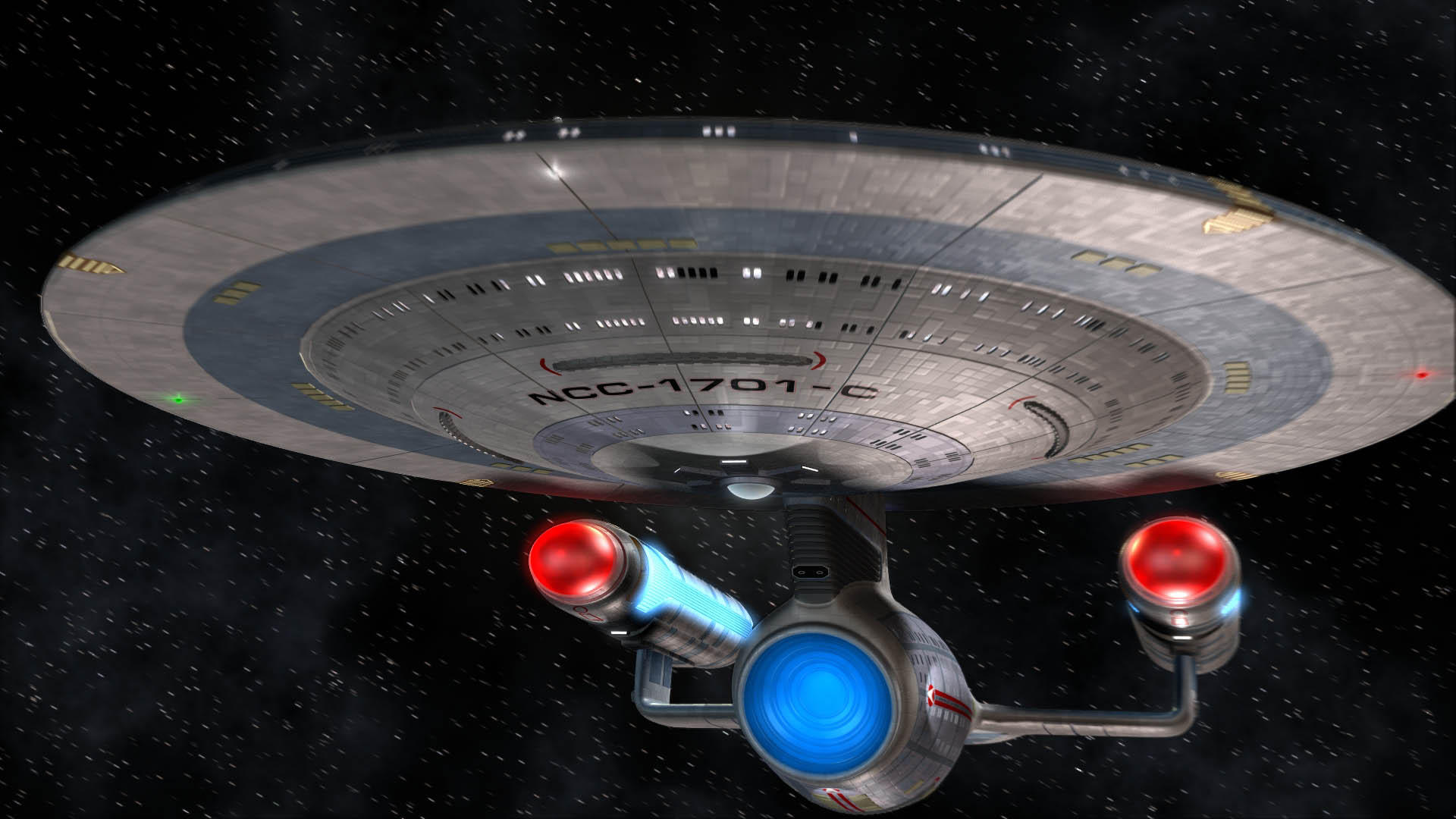
Still, the departure of the Enterprise is a fine showcase of solid direction, great special effects, wonderful editing and of course, James Horner's rousing score. I've said it before and I'll say it again, this version of the Enterprise is still my favorite, with the possible exception of the Enterprise-C. And don't even mention that hideously-ugly, top-heavy abomination the Enterprise-D. Just look at that gaudy saucer section, talk about overcompensation. She's like the Federation's answer to a Sport Utility Vehicle.
As soon as Khan gets wind of the destructive potential of Genesis he goes nuts and attacks space station Regula I. And yes, once again, we get that timeless Star Trek cliché which dictates that the Enterprise is "the only ship in the quadrant" that can respond to this emergency. Back in 1982 this plot device hadn't been completely run into the ground just yet; it would take another ten years and a series of terrible Next Generation films to make me hypersensitive to this hoary, old trope.
The scene in which Kirk takes command of the ship is fantastic. It contrasts nicely with a similar scene in The Motion Picture when Kirk usurps the captain's chair from Deckard, who promptly throws a hissy fit. Indeed, Spock's reaction to this request couldn't be more different.
This scene between Shatner and Leonard Nimoy features both actors at the top of their game:
In my opinion, this is one of the best Star Trek moments ever. The "commanding a starship is your first best destiny...anything else is a waste of material" quote can be applied to just about anything. All you need to do is take out the "commanding a starship" part. For example:
"Being a caretaker at a clothing-optional resort is your first best destiny...anything else is a waste of material."
See? Works like a charm!
Seriously, the rapport on display here isn't fictional. It isn't an edifice. It isn't two actors "acting". It's two very old and dear friends, who've clearly been through the shit together, sharing a moment of genuine camaraderie and friendship. It just so happens to be in the middle of an eleven-million dollar sci-fi film. The characters of "Kirk" and "Spock" are merely the fictional conceits worn by these accomplished actors while immersed in this wonderful, speculative playground.
Meanwhile, on the other end of the galaxy, Khan is showing some distinctly Ahab-ian leanings. Even though he's escaped Ceti Alpha V, has the Reliant at his disposal and can go anywhere in the galaxy, he still wants Kirk's head on a space-platter:
I mean, c'mon, how awesome is that delivery? You can just feel the palpable rancor, the seething rage and the barely-concealed bat-shit nuttery lurking just below the surface.
Star Trek II: The Wrath of Khan piles on one iconic scene after another. Via one of the earliest examples of computer generated special-effects, we get to see what Genesis is really capable of. This immediately sparks a fierce debate between Spock and McCoy:
McCoy: Dear Lord. You think we're intelligent enough to... suppose... what if this thing were used where life already exists?
Spock: It would destroy such life in favor of its new matrix.
McCoy: Its "new matrix"? Do you have any idea what you're saying?
Spock: I was not attempting to evaluate its moral implications, Doctor. As a matter of cosmic history, it has always been easier to destroy than to create.
McCoy: Not anymore; now we can do both at the same time! According to myth, the Earth was created in six days. Now, watch out! Here comes Genesis! We'll do it for you in six minutes!
This dialogue-based distillation of a mondo-heavy issue is precisely what makes Star Trek unique. The original show always used its sci-fi veneer to tackle real-world, hot-button topics with impunity. In the case of Wrath of Khan: just because technology makes it possible for us to do something it doesn't necessarily mean that we should.
Such interesting and weighty issues are completely absent from the J.J. Abrams flicks. They're like Spock after his brain was stolen by those interstellar go-go girls: geeky on the outside but devoid of any substance on the inside.
Next up Khan "Pearl Harbors" the Enterprise in yet another memorably-thrilling scene.Now a case could probably be made that the whole "Prefix Code" thing is yet another script convenience but I beg to differ. After all, we live in an day and age when anti-theft devices can shut down a car's electrical system when it's stolen, so I'm more than willing to give this one a pass. Besides, the scene has some pretty awesome practical effects and is tense as all get-out.
Kirk and company barely escape with their wits and hides intact and when they finally arrive at space station Regula I they discover just how wrathful Khan really is. As if the introduction of the Ceti Eel wasn't horrifying enough, director Nick Meyer takes us through a spooky exploration of the now-abandoned laboratory. This creepy scene is executed with considerable panache, ending with a jump scare that feels as if it belongs in a friggin' Alien movie.
Frankly, I think it's good to see Star Trek dragged kicking and screaming into more mature and decidedly un-geeky territory. The makeup department, led by Werner Keppler and James Lee McCoy, provides some pretty wince-inducing burn effects which actually caused my stomach to roll a bit as a squeamish kid. Some might argue that such things don't belong in a Star Trek film but I think it off-sets the cheese factor while showing that there are consequences to violence, even space-violence.
The script does a great job convincing us that Khan has and always will have the upper hand. After stealing the Genesis torpedo and marooning Kirk and company in the supposedly-dead heart of Regula, we get one of the best moments in sci-fi, nay, cinema history:
The film finally lets up for a moment to give the audience a much-deserved breather. During this brief respite we see the positive application of Genesis, spend some quality time with the engaging Bibi Besch as Carol Marcus, witness some verbal sparring between Kirk and Saavik and learn some fun facts about David's lineage. This brief interlude comes at the perfect time, we have just enough time to catch our breath before moving on to the explosive finale.
And what a finale it is. Kirk goads the obsessive Khan into the Mutara Nebula, ensuring that the crippled Enterprise will be on the same combat footing as the Reliant. What follows is a brief but intense Run Silent, Run Deep cat-and-mouse game that sees the more experienced bridge crew of the Enterprise even the odds. ILM's visual effects provide plenty of spectacle but it's the scripts investment in the main characters that makes this final confrontation so meaningful.
Defeated, Khan activates the Genesis wave in a last, desperate bid to murder his hated rival all the while quoting liberally from Moby Dick.
This leads to one of the most heroic, dramatically-appropriate character deaths in the history of cinema. In light of the earlier scene in which Spock casually hands the keys of the Enterprise over to Jim, their final exchange together is downright heart-rending.
Star Trek II: The Wrath of Khan is the perfect storm. The cast is on-point, the stakes are high, the plot is propulsive and there's plenty of juicy sub-text to ponder. The thrilling special effects and actions beats are there to serve the story and not the other way around. This is in stark contrast to these two recent S.T.I.N.O. (Star Trek In Name Only) movies where the kinetic visuals end up being the bedazzled tail that wags the dog.
Even though the Star Trek films are justifiably episodic, Wrath of Khan is the first in the so-called "Spock trilogy" that continued with The Search for Spock and ended with The Voyage Home. Over the next little while I'll be taking a look at all of these films to see how they stack up with one another.
Spoiler (red) alert: Star Trek II was so good that it inadvertently had a detrimental effect on the series, adversely influencing the Next Generation flicks as well as the reboots. Soon smart ideas and social commentary gave way to a photon torpedo spread of mindless action, uninspired villains and endless digital eye candy.
Even in light of this, we really can't slight Star Trek II: The Wrath of Khan for its original achievements. The movie came from a place of creative sincerity and it single-handedly shot the venerable sci-fi franchise back into warp speed.
Back in 2009 I wrote the following about Neill Blomkamp's feature-length debut:
"Mark my words: District 9 will go down in film history as one of the most important sci-fi movies ever made. It's the best genre film I've seen since The Matrix in terms of offering up the complete package of spectacle and substance."
Well, in the intervening five years Blomkamp has given us the overly-preachy Elysium (2013) and the tonally-schizophrenic CHAPPiE (2015). Because of this, some people may call into question the quality of his Freshman effort but I'm here to re-assure you all that it's still an immutable modern classic.
Neill Blomkamp and Terri Tatchell's script posits an alternate history, one in which a massive alien spacecraft comes to rest above the city of Johannesburg in 1982. After three months of unnerving silence, the people of earth decide to take it upon themselves to cut their way into the ship, discovering a large clutch of half-starved alien worker drones inside. In what is initially viewed as a humanitarian action, the creatures are brought down to the planet's surface and housed in a temporary settlement called District 9.
But during the next twenty years, the settlement degenerates into a shantytown and then into a slum, causing enmity and mistrust to breed between the humans and the derogatorily-dubbed "prawns". When oversight of the aliens is farmed out to a private company called Multi-National United things quickly go from bad to worse. M.N.U.'s "sympathy" for the visitors is clearly mercenary since they're a lot more concerned with unlocking the genetic code that will give them unrestricted access to an arsenal of exotic alien weapons.
When a skittish M.N.U. desk-jockey named Wikus van de Merwe (Sharlto Copley) is charged with the daunting task of evicting close to two-million aliens from District 9 all hell breaks loose. During the operation Wikus gets spritzed by alien DNA, triggering his Kafka-esque mutation into one of the "prawns". Since he can now operate the alien weapons, Wilkus becomes the most valuable commodity on the planet. This leads to a daring escape, several interesting revelations about the visitors, a series of thrilling confrontations and considerable social commentary.
Although District 9 is partially shot like a documentary, it mercifully avoids the incessant stomach-churning camerawork of a found footage flick like Cloverfield. Although we do get some scenes with characters attempting to capture the action with "hand-held" cameras, there are also lots of of faux-interviews with "talking heads" who comment on the proceedings. Add in plenty of standard cinematic blocking and framing and the viewer remains well-grounded both visually and narratively.
The special effects are a mixed bag but serve the story quite well. The sight of that massive alien spacecraft silently parked high above the city is both convincing and disturbing. The aliens aren't quite as photo-realistic but their unique physiology and design make them compulsively watchable. Finally, the various stages of our hero's transformation evokes shades of Jeff Goldblum's icky physical degeneration in David Cronenberg's The Fly.
It's pretty self evident that the role of Wilkus was insanely challenging but Sharlto Copley was clearly up to the task. Given how much abject misery the character goes through you know that Copley really suffered for his art here. Jason Cope also does some excellent motion-capture work as Christopher the alien, engendering the character with lots of nuance and personality. As for the antagonists, David James is intimidation incarnate as the bigoted, eternally-aggro, meat-headed merc Colonel Koobus Venter.
Words can't describe how happy I am that this script by Blomkamp and Terri Tatchell's dares to take the road less traveled. I loved the fact that Wikus begins the story as a hideously-flawed asshole who's motivated almost entirely by self-preservation. Even though he's clearly the protagonist, his actions are so genuinely selfish that he single-handedly justifies the alien's mistrust of humans. Mercifully the character also has a wonderfully-rich redemptive arc, something virtually unheard of in today's genre films.
This fictional scenario also comes complete with a ton of thematic relevance and sly, real-world social commentary. First off, it's no co-incidence that the alien ship first appears over Johannesburg, site our very own complicated history of racism and intolerance. Blomkamp and Tatchell also get a lot of mileage out of the "bio-mechanical" nature of the aliens and humanity's maddening inability to exploit their advanced technology.
As if deep and original concepts weren't enough to recommend the film, it's also entirely thrilling on a completely superficial level. There comes a point in time when the film completely cuts loose, racing towards a frantic, four-way clash between the aliens, a bunch of M.N.U. goons, a horde of
heavily-armed Nigerians (!) and Wikus in a robotic exo-suit (!!!). This bat-shit insane finale is a veritable tour de force of editing, digital tickery, and set-piece design. When Wikus flings a car that is barreling down on him over his head I actually experienced a moment of pure, giddy, child-like glee.
Peter Jackson helped bankroll the film and it's not hard to understand why: the script features the same sort of cock-eyed dark humor and skewed sensibilities that characterized much of his earlier horror efforts. Personally I'm just relieve that the studio system is still capable of surprising me, producing a modern-day sci-fi masterpiece that manages to distinguish itself from the usual Hollywood dreck.
With all of the recent hubbub about American Sniper lately I thought that I'd look back at another sharp- shooter-centric war movie: Enemy at the Gates.
The year is 1942 and the Nazi war machine is in full flight. The Germans have invaded Russia with their sights set on capturing the oil-rich Caucasus region. The final levy standing between the Wehrmacht tsunami and this key objective is Stalingrad. For Hitler, the destruction of the place that bears the name of his Bolshevik rival quickly becomes an obsession and soon the city is reduced to nothing but a rubble-strewn meat grinder. Ultimately hundreds of thousands of Axis and Allied soldiers would perish in this extended battle of attrition.
Thrown into this deadly mix is Vasily Zaytsev (Jude Law), a former sheep-herder from the Urals who nearly dies in one of many involuntarily-suicidal Red Army charges. After retrieving a rifle from a dead comrade he manages to save his own life and the hide of one Commissar Danilov (Joseph Fiennes). Impressed by the young marksman's deadly skills, Danilov convinces superior officer Nikita Khrushchev (Bob Hoskins) to channel their propaganda efforts away from fear and threat and towards heroism. Danilov soon transforms Vasily into a bonafide Russian hero, replete with tales of inhuman skill and unflagging heroism.
Eventually Vasily's Nazi officer kill count snags the attention of the German High Command who introduce their own deadly sniper, Major Erwin König (Ed Harris), into the theater. The rest of the film details the deadly cat-and-mouse battle between the two rivals as well as a budding love triangle between Vasily, Danilov and a spirited and beautiful freedom fighter name Tania Chernova (Rachel Weisz).
Writer / director Jean-Jacques Annaud kicks off the film with an epic set piece that I'm convinced was at least partly inspired by the harrowing D-Day beach landing sequence in Saving Private Ryan. The first thing we see is the incongruous sight of Red Army "recruits" being herded like cattle onto train cars and then transported to the front. When they arrive in Stalingrad they're immediately packed onto unprotected landing boats and then sent across the Volga River under a hail of withering German artillery fire and unopposed strafing runs by the Luftwaffe.
When the surviving soldiers reach the besieged bank of the Volga, their promptly hauled out of the boats and driven towards the front lines under threat of execution. En route officers armed with bullhorns shout the following chilling mantra over and over again:
"One out of two gets a rifle. The one with the rifle shoots! The one without, follows him! When the one with the rifle gets killed, the one who is following picks up the rifle and shoots!"
Needless to say endless waves of demoralized Soviet troops are callously mowed down by German machine gun and tank fire. There are few sequences on film that truly convey the nightmarish and futile nature of war and how cheap human life can be. This is really driven home moments later when the tattered remains of the Russian ranks try to retreat and are gunned down by their own barrier troops for "cowardice".
This terrifying prologue is an absolute triumph of direction, pacing, art design and visual effects. Clearly the scale of the scene was augmented somewhat with nascent-level CGI and digital matte paintings but Wolf Kroeger's gritty production design and the authentic costuming of Gudrun Leyendecker and Janty Yates help preserve a strong sense of authenticity. Throw in some crackerjack editing by Noëlle Boisson and Humphrey Dixon and a stirring soundtrack by composer-extraordinaire James Horner and you've got a truly memorable sequence that packs an emotional wallop.
The cinematography of Robert Fraisse also deserves a special nod considering that the film's drab visual palette could easily have degenerated into a monochromatic mess. Mercifully, Fraisse uses a keen eye and some judicious color timing to wring a surprising amount of visual variety out of the sets and the costumes. At no point does the film become a chore to watch.
The screenplay was adapted from the book Enemy at the Gates: The Battle for Stalingrad by William Craig. It's pretty clear to even the most casual viewer that certain story elements have either been fabricated or enhanced to ramp up the drama. Mercifully these additions aren't treated as a burdensome afterthought and considerable screen time is earmarked to develop them.
For example the love triangle between the three leads actually emerges rather organically from the story proper. Starchy, bureaucratic Danilov clearly pines for the passionate, vengeful Tania but she's, in turn, completely smitten with the brave and heroic Vasily. Hints of their potential relationship are planted early and come to fruition in due time. As a side note, this also results in one of the most unconventional and smoldering sex scenes in cinema history as Tania seduces Vasily in the squalid and crowded confines of an underground muster station.
Equally fictionalized is the back-and-forth battle of wits between Vasily and his German counterpart. Again ample time is invested in turning König into a real, live three-dimensional human being who has his own motivations to enter the arena. The tactics and counter-moves employed by the both snipers have a field-tested authenticity that makes these scenes riveting to watch.
Pity the strong scripting isn't sustained throughout the entire film and Annaud and his co-screenwriter Alain Godard seem to lose their way slightly during the endgame. Naturally, König is tasked to do something uncharacteristically evil just to remind us that he's a filthy, stinkin', despicable Nazi. He does this merely to lure Vasily into a typical hackneyed Hollywood-style face-off that makes very little logical sense given what we've seen so far. It's as if König starts acting like an idiot merely because the screenwriters were getting concerned about the script's page-to-screen-time ratio.
In spite of this, the cast is universally solid right across the board. Yes, it would have been nice if only Russian actors were cast but, hey, what are you gonna do? First up, Jude Law gives a wonderfully honest and unpretentious showing as Vasily Zaytsev. It's pretty easy to buy him as a simple shepherd manages to persevere through terrible circumstances thanks to his unconventional skills. During a well-mounted scene in which Vasily tries to deter Tania from becoming a sniper he talks about what its like to have a potential victim in his sights:
"He doesn't know you exist, but at that moment you're closer to him than anyone else on earth. You see his face through the sign. You see whether he shaved or not. You can see whether he's married if he's got a wedding ring. It's not like firing at a distant shape. It's not just a uniform. It's a man's face. Those faces don't go away. They come back and they get replaced by more faces."
Coming off his stellar success in Shakespeare in Love three years earlier, Joseph Fiennes was a pretty hot property at the time. It's a bloody shame that he hasn't done much of note recently unless, of course, you include such time-wasting dreck as 2014's Hercules. His performance here is spot on: twitchy, skittish and informed by an undercurrent of self-doubt, longing and resentment. Danilov is brave and skilled in his own right but his ivory tower existence just isn't sexy enough to attract the passionate Tania.
Danilov does whatever he can to keep Tania out of harm's way, which sets up a Shakespearean-style tragedy in its own right. When Danilov writes a false, unflattering report about Vasily during a fit of jealousy, Fiennes had me convinced that this was going to be the least of his transgressions. His final speech is pretty meaty stuff, with plenty to say about the inherent flaws of communism specifically and human nature in general:
"I've been such a fool, Vasili. Man will always be a man. There is no new man. We tried so hard to create a society that was equal, where there'd be nothing to envy your neighbor. But there's always something to envy. A smile, a friendship, something you don't have and want to appropriate. In this world, even a Soviet one, there will always be rich and poor. Rich in gifts, poor in gifts. Rich in love, poor in love."
As a female character in a war movie, Rachel Weisz goes through a pretty respectable character arc as Tania. At first glance she appears to be a studious interpreter but as the siege of Stalingrad wears on she quickly becomes a highly-capable member of the militia. And then, when Nazi atrocities hit even closer to home, she transforms into a cold-hearted seeker of vengeance, which makes her rejection of Danilov's offer of comfort and safety forgivable. Weisz is surefooted throughout: alternately warm, fierce and charming. Her presence in the film is a great tribute to all of the real Soviet women who fought alongside men during World War II.
Now by all accounts Nikita Khrushchev was a relatively minor player in the defense of Stalingrad so I assume that his profile was increased just for name recognition value. Whatever the reason, it adds up to win for the audience since the part is played with gusto by the late, great Bob Hoskins. Clad in his authentic commissar uniform and transformed by a convincing make-up job, Hoskins vacillates between belligerence, ruthlessness and parent-like pride for his rising star Vasily. Whether he's reveling in coal black humor or delivering thinly-veiled threats to Danilov, Hoskins is equally game.
Ignoring the fact that everyone is slightly miscast due to the proliferation of English accents, Ed Harris feels particularly out of place here. Nevertheless he acquits himself rather well, turning in an understated and intense performance as Major Erwin König. Given what we eventually learn about König's personal ties to the battle, his emotionally-bloodless line deliveries are well in-step with these revelations. Contrary to his outward veneer of steely calm, Harris gives the impression of a tightly-coiled bear-trap that could spring at any moment. This helps to reconcile the character's increasingly-sloppy and erratic behavior towards the end of the film.
If the goal of Jean-Jacques Annaud and company was to convince the viewer that war is hell while highlighting the inherent bravery, fortitude and valor of its heroes, then Enemy at the Gates is a real winner. I can't wait to watch American Sniper to see how a modern story compares.
This completely loopy comedy doesn't make a lick of sense but it does assault the funny bone with the same intense fervor that Fox News usually reserves for Obamacare.
Here's the high-concept set up: four male friends, bored and disillusioned with adulthood, find themselves teleported back in time by the titular device. They end up at debauchery ground zero: the same ski resort they frequented as carefree youths. Not only has the site been restored to its mid-Eighties glory, so have our forty-something time travelers!
Freshly dumped in the present-day by his latest girlfriend, Adam (John Cusack) gets a second chance with a super-hottie named Jennie. Faced with the prospects of a dead-end job and a cheating wife back in 2010, Nick (Craig Robinson) is once again at the height of a nominal hip-hop career with groupies aplenty. And Lou (Rob Corddry), a self-prescribed metal-head and party animal who's been warning his buddies about the dangers of adult domesticity, finds himself sporting a re-constituted mullet and immersed in a misc-en-scene ripe for insanity.
Adam's Real Life-obsessed 20-year-old nephew Jacob (Clark Duke) gets pulled along for the ride. Although his age remains unaltered he starts to wink in and out of reality with alarming frequency. This begins the film's great debate: do they stay in the past to take advantage of this second kick at the can or do they return to their own era to avoid tampering with the time line? Since responsibility isn't exactly our hero's collective strong suit, this quickly becomes grist for a surprisingly-productive comedy mill.
In retrospect, Adam realizes how vapid Jennie is but this time out he becomes the dumpee. The script conveniently provides him with another potential soul mate: a free-spirited music journalist named April. Despite knowing that his wife is chronically unfaithful, Nick has a hard time sticking to the "we gotta do exactly what we did in 1986" plan. The scene where he weeps uncontrollably while having sex with a groupie is priceless. Lou is particularly conflicted since he's destined to be pummeled into oblivion by ski-instructor Blaine (Sebastian Stan), but he's also back in his element as a wannabe roadie for Motley Crue. Pretty soon he's doing whatever he can to undermine the efforts of his more conscientious buddies.
Gross-out comedies are a dime a dozen so why not recognize the ones that are actually pretty funny? This flick serves up its heart, soul and dignity for your amusement. Director Steve Pink, the screenwriter behind two of my favorite Cusack comedies High Fidelity and Grosse Pointe Blank, keeps things moving with manic energy. If you miss a gag or a funny line reading then just hold on Abigail Mae; in a few seconds a vomit-covered frozen squirrel will meaner into the scene to screw up someone's sure bet.
The screenplay by Josh Heald, Sean Anders and John Morris goes for broke with a veritable conveyor belt of shockingly-tasteless scenes. The presence of Crispin Glover's Phil, whom the other characters want to see maimed in a ghoulishly-nasty moment of fate, is reason enough to watch the film. Sad souls such as myself who actually grew up in that hideously-garish era will have fun spotting other 80's icons like William Zabka, who played Daniel's douchebag rival in The Karate Kid, and Chevy Chase who picks up a check as the hot tub time machine repairman (?).
All the leads are great sports and totally on top of their game. Then again, they'd have to be in order to keep up with Ron Corddry's borderline-psychotic Lou. Everyone knows someone similar to Lou, someone who's clearly not all there but is still strangely endearing probably because you've been through so much together. Credit Corddry for inhabiting a character that's more charming than obnoxious.
John Cusack is his usual watchable self. Craig Robinson is stellar as well. When Nick drunk-dials his nine-year-old future bride and then calls her down to the dirt I nearly died thanks to Robinson's over-the-top delivery, the sheer audacity of the writers and because I knew what impact it was going to have on his future. Clark Duke's Jacob plays a perfect straight man and main foil to Lou, speaking about the "scientific" properties of the hot tub with straight-faced authority with such lines as: “Hey, I write Stargate fan fiction; this is my bread and butter, man!”
Be prepared to crash around with the characters in Hot Tub Time Machine. The action flies all over the place, things happen for no logical reason, the special effects are ludicrous, and we're often subjected to a torrential checklist of bodily fluids.
Fortunately the movie also happens to be friggin' hilarious.
This is gonna be a fairly in-depth analysis and, as such, I'm gonna dip inordinately deep into spoiler territory. Watch first and then read this later!
If you were to ask me to name a movie that best epitomizes the "magic of cinema", I'd be quick to mention Close Encounters of the Third Kind. Like Star Wars seven months earlier, I distinctly remember stumbling out of the theater after seeingthe film as a kid back in November of 1977, looking up at the sky and feeling as if I'd been changed somehow.
When electrical worker Roy Neary (Richard Dreyfuss) responds to a swath of late-night power outages he has an experience that will forever alter his life. His service truck conks out near some train tracks and he's blasted from above by a blinding light. When he looks out to determine the source of the disturbance one
side of his face gets burnt beet red. The nearby railroad crossing sign starts undulating wildly like a spastic metronome and a hive of mailboxes begin to open and close all by themselves. Gravity goes nuts inside the cab of the truck, sending flotsam and jetsam spining everywhere.
After the odd phenomenon abruptly ends, Roy spots a huge, silent object floating away overhead. He gives chase and eventually gets a really close look at some unidentified flying objects. During the pursuit he nearly runs over three-year-old Barry Guiler (Cary Guffey) who's been running after someone (or something) that just broke into his rural home. His distraught mom Jillian (Melinda Dillon) is too stunned by what she's just seen to be mad at Roy and the two immediately bond over this strange sighting.
They both become obsessed with the encounter and are haunted by the vision of a mysterious, volcano-shaped mountain which they try to re-create using such diverse media as pencil, sculpture and mashed potatoes. Things turn particularly grim when little Barry is abducted by the aliens and Roy's wife Jillian (Teri Garr) leaves her husband after he builds a giant butte in the middle of their living room.
But when Roy and Jillian witness news reports about a nerve gas accident near Devil's Tower in Wyoming, things start to fall into place. Motivated by an inexplicable drive for answers, the pair make a pilgrimage to the area, hoping to sneak into the quarantine zone. Almost immediately they're arrested, questioned and sent packing. At the last minute, Roy gambles that the crisis is a sham and dashes off with Jillian. Together they make a final desperate bid to fulfill their cosmic invitation and experience the ultimate close encounter: contact.
Close Encounters of the Third Kind is definitely the product of its time and if Spielberg tried to make it today I think it would turn out a lot different. First off, the esoteric title would stymie the movie marketing morons and would probably be changed to something like Invasion From The Stars, Keep Watching The Skies! or The Fast and the Futuristic. The age demographic of the two leads would likely be dropped from thirty-something to twenty-something. It's also highly improbable that Frenchman François Truffaut and plain-jane Melinda Dillon would never be cast.
I suspect that the secondary / concurrent story-line with the scientists would also be jettisoned, thus compromising a major source of the film's aforementioned "magic". Check out that freaky, yet vaguely superfluous opening sequence in which researcher Claude Lacombe (François Truffaut) and his ersatz interpreter David Laughlin (Bob Balaban) find a fleet of missing, mint-condition World War II-era fighters sitting in the middle of the Mexican desert, sans pilots. When they question an old man who witnessed their sudden and inexplicable appearance he simply tells them that "the sun came out at night and sang to him."
I'm convinced that Chris Carter probably saw Close Encounters at the perfect time and it heavily influenced his work on the X-Files. This, in turn, had a positive creative ripple effect on countless other movies and T.V. shows. Consider how many times your attention's been piqued by some weird, seemingly-unrelated hook at the beginning of a television program. A hook that, at face value, has nothing to do with the show's continuity or the first twenty minutes of the episode. It works because it defies expectations, shatters conventional story-telling structure and gives us a juicy mystery to ponder right off the bat.
More weirdness abounds in the script. We watch on pins and needles as an air traffic controller presides over a close encounter between two passenger jets and another unidentified aircraft that displays unearthly speed and maneuverability. He asks the pilots if they want to report a UFO but they sheepishly decline, perhaps fearing the repercussions of doing so. Later on in the film, Lacombe and Laughlin come across a missing cargo ship just lying in the middle of the Gobi Desert. As a kid growing up in the 70's all of these mind-blowing oddities dove-tailed nicely with Bigfoot, Crystal Skulls and the Bermuda Triangle.
Things get even trippier when a bunch of odd lights in the sky transmit a five-note musical phrase to hordes of people in Dharamsala, India. The scientists beam the notes back into space and receive what appear to be random numbers in return. Eventually it's determined that the digits are a set of co-ordinates centered around Devil's Tower in Wyoming. This sets off a series of events that completely shattered my fragile eggshell mind as a kid.
Clearly Spielberg and his generation were still working through the implications of the Watergate scandal. Indeed, Close Encounters of the Third Kind was my very first introduction to the concept that people in authority can lie to you. To prevent widespread panic and ensure that there are no eyewitnesses to the big interstellar rally, the military concocts a fraudulent nerve gas leak story in order to evacuate thousands of locals from the surrounding area. When I first saw the film I missed the whole part about the military using knock-out gas and left the theater thinking that the army had slaughtered all of the local livestock to give credence to their lie. That's a pretty hefty thing for a seven-year-old kid to process.
Another thing that Spielberg himself would probably not do nowadays is have his main character flat-out abandon his family. We get some hints of this early on in the film: Roy's model train set dominates the living room and later he tries to cajole his unimaginative family into seeing Pinocchio, the story of a puppet becoming a real boy. This last reference also foreshadows Roy's gelotophobia, the fear of being laughed at.
In 1976 Steven Spielberg was thirty years old, single and without kids. His script for Close Encounters seems to hint at a fear of commitmentand responsibility. Roy is a man-boy who likes model trains and cartoons and his real-life obligations are slowly beating the inner child out of him. The aliens represent imagination, alternatives and wonder, not fear or obligation. Little Barry isn't scared of the visitors and neither is Roy, but all of the other adults see them as either a threat or as a hoax.
The film also functions quite nicely as a mid-life crisis analogy. Roy is immediately fired from his stressful, thankless job the second he talks about UFO's on TV. His wife is a boring, unimaginative, shrew who has nothing but disdain for his flights of fancy. His kids are ungrateful, destructive, emotionally manipulative little hooligans. Roy's terrestrial life is so dull and pointless there's no wonder why he wants to find the aliens and fly off with them. The visitors are like a hot, young, new love interest who comes along, thinks you're fascinating, wants to get to know you better and then tempts you to run away with them on some crazy, irrational adventure where the possibilities are, once again, endless.
Yes, you can have a field day with all of this sub-text but you can also enjoy the movie on a purely superficial level. The household banter and chaos of the Neary household is achingly real and rife with subtle humor. When Roy impatiently waves at the traffic behind his truck to move along only we're privy to the sight of the "headlights" rising up and out of frame instead. The aliens activate all of Barry's wind-up toys, leading to a cacophony of cymbal-clanking monkeys, grinding gears and flashing laser beams.
Countless evocative moments abound in this film. You can almost smell the bug-off, roasting weenies and warm summer air as a group of amateur UFO enthusiasts anxiously await the return of their extraterrestrial friends. The alien ships resemble airplane guide-lights shrouded in a corona of fog, giving them just enough authenticity to feel real. To this day I still think of Close Encounters whenever faced with opposing traffic cresting a distant hill on the highway. I fully expect those high beams to start strobing, change colors and then launch off the top of the hill and fly overhead.
It wasn't just thoughts of government conspiracy that scared the ever-lovin' shit outta me; I was also completely traumatized by Roy's increasingly-erratic behavior. As a kid, your trust in adults is absolute and if they start acting weird, your whole world gets rocked. When Roy starts taking fully-clothed showers, sculpting his side-dishes and weeping openly at the dinner table the resulting strife felt uncomfortably real and very scary to me. Mercifully the tone does lighten up when Roy begins his unconventional, in-house landscaping project but up to that point it was pretty rough going for this l'il shaver.
And then there's the film's two bravura moments, the first being the abduction of Barry. Very few movies succeed in generating the sort of cresting tsunami of dread that this scene engenders. The aliens herald their arrival with roiling, apocalyptic-looking storm clouds, instantly evoking shades of Norman-Rockwell-meets- Invaders-from-Mars when superimposed high above Jillian's impeccably color-timed farmhouse. Thanks to a perfect storm of taut direction, excellent lighting, and John William's amazing score, this sequence becomes the stuff of pure, unadulterated nightmares.
Jillian does her best to barricade the house against imminent invasion and prevent her son from voluntarily waltzing out the front door. But as soon as Spielberg gives us a macro view of bolts slowly unscrewing out of the floor vent by themselves we just know that the kid's disappearance is inevitable. I think this was the first time that this gimmick was ever used in a film and when you add it to the rest of Spielberg's technical virtuosity, it results in one of the most thoroughly-effective and unnerving scenes in cinema history.
Then we have the big, götterdämmerung alien / human summit in the shadow of Devil's Tower. Again Spielberg serves up the perfect confection of convincing sets, organic dialogue, and exponentially-dazzling sights. Although Steven certainly deserves the lion's share of praise, credit must also go to editor Micheal Khan for taking such a complicated finale and making it tight, crystal clear and packed with one jaw-dropping spectacle after another. If not for Star Wars, I'm convinced that Khan would have won the Best Editing Oscar in 1978.
Contributing to the film's bling-factor is Douglas Trumbull's special effects. To this day, his work is incredibly convincing and the appearance of the massive mother-ship is still a crowd-pleasing, jaw-dropping visual barn-burner. Aided considerably by the stellar work of veteran cinematographer Vilmos Zsigmond, the movie looks fantastic throughout and the final sequence especially so.
Perhaps the only place where the film stumbles a teensy bit is in the reveal of the visitors. The first creature, a spindly, marionette-type thing, looks super-freaky at first but then we get a side-shot where we can clearly see some kind of support beam behind it, which probably explains why we never see it again. Then, for the little "gray aliens", Spielberg dresses up a bunch of kids in skin-tight outfits with over-sized heads, pot bellies and spindly fingers. This works reasonably well since Spielberg shoots them at all a distance, in silhouette and then Micheal Khan's judicious cuts ensure that no one shot lingers on them for too long.
Finally we see the lead ambassador alien, rendered as a full-sized puppet designed by renowned animatronics expert Carlo Rambaldi. Given the liberal application of back-lighting, filters and smoke, the blinking, smiling, head-tilting creature looks legitimately other-worldly and pretty darned authentic. The illusion starts to break down somewhat when the thing is tasked to return Lacombe's Curwen hand signs. The "skin" looks rubbery and the movements are very mechanical, bringing to mind "Disney's Country (Alien) Bear (Hybrid) Jamboree". Clearly this technology was refined quite a bit by the time Spielberg got around to making E.T. four years later.
But the film isn't all about special effects and flashy technology; the human element is also top-notch. Richard Dreyfuss is very relatable: a frustrated, confused everyman who didn't ask to see anything strange, but now that he has and can't un-see it, he's driven to seek the truth at all costs. Everything Dreyfuss brings to the table: the mania, the fear, the epiphany, the anger and the sense of wonderment are all completely convincing. The scene where he's grilled by Lacombe and Laughlin about his presence in the quarantine zone is a true tour de force:
Speaking of Lacombe, François Truffaut was certainly an unconventional choice to play a lead character in an American-made sci-fi film. Nowadays, Truffaut is mainly remembered as a director of art films and not as an actor. Although I do believe that his thespic talents were somewhat limited, his showing in Close Encounters is perfectly serviceable. As a scientist and a researcher, we don't need him to be warm and cuddly. In fact, his "cold fish" approach to the material keeps us guessing about his motivations right up to the very end.
Melinda Dillon is perfectly cast as fretful and anguished single mom Jillian Guiler. Bereft of make-up and possessed of a world-weary bearing that instantly conveys both exhaustion and concern, I totally bought her fictional relationship with little Cary Guffey. It's agonizing to see Barry get ripped right out of Jillian's hands and then watch her get pulled through a knothole of public scrutiny that calls her competence and even her sanity into question. On the flip-side, her joy in finding Roy as a loyal ally is exhilarating and her reaction to the finale is particularly stirring.
The film is also graced by a series of memorable minor performances. Teri Garr is great as Roy's persistently out-of-patience wife Ronnie. Spielberg used very clever and innovative visual and audio techniques to wring a completely authentic performance out of then-three-year-old Cary Guffey. And finally Bob Balaban is cool and collected as cartographer-turned-interpreter David Laughlin.
Close Encounters was made at the perfect time, back when Steven Spielberg was a hot, young, hip, up-and-coming film-maker who managed
to wed the unconventional scripting of a Seventies-era maverick auteur with the directorial chops of Alfred Hitchcock. Obvious sentimentality and shmaltz hadn't crept into his films yet. Roy's willingness to abandon his family to fly off with the visitors would be a pretty unpopular choice with contemporary audiences, but back then it sprang from an honest place and I applaud Spielberg for having the gusts to follow through on it.
As such, I still maintain that Close Encounters of the Third Kind is one of the most complex and rewarding pictures in all of Spielberg's celebrated body of work.


_in_spacedock%2C_aft.jpg)