Monday, October 8, 2012

Movie Review: "Insidious" by David Pretty


The title of this film is actually a perfect way to describe the extent in which the producers rip off a host of superior movies.  After an atmospheric and effective first half, director James Wan (of Saw fame) follows through on his premise but, in doing so, leads the film into increasingly derivative and and ineffectual waters.


Horror film fans have seen this premise a hojillion times before: work-a-day family, looking for a "fresh start" moves into a new house with their kids and almost immediately weird shirt starts happening.  What makes Insidious so frustrating is how this hackneyed set up is made fresh in its execution.  Wan gives us some unearthly spine-jangling voices via baby monitor, phantasmal B&E's and creepy now-you-see-it-now-you-don't figures loitering around in the backdrop.  All of this takes place in a house who's door hinges have apparently never tasted a drop of oil since they were installed.    

Wan lifts liberally from other sources, but at least his thefts are effective.  He cribs hair-raising musical cues straight from The Exorcist and nouvelle mom Rose Byrne's exploration of the house's unsettling attic evokes shades of Ellen Burstyn's delve nearly forty years earlier.  He also manages to out-paranormal Paranormal Activity without so much as a single frame of listless "found footage".  Quite the opposite: his set-ups are evocative and arresting.


Mercifully, at the thirty-eight minute mark, besieged mom Renai (Rose Byrne) tells her husband Josh (Patrick Wilson) that she wants to "leave this house".  With Paranormal Activity serving as precedent, screenwriter Leigh Whannell has to come up with an excuse to transplant the spooks.  So, although the family does indeed relocate to a new home, the spectral occurrences actually accelerate.  I always thought that I was alone in thinking that Tiny Tim's "Tip-Toe Through The Tulips" was the stuff of nightmares, but I'm heartened to learn that I'm not alone.  

Even as the rip-off...er, homages continued to pile up, I was still on board with the film.  Poltergeist was next on the inspirational hit-parade, as an eccentric older woman and her paranormal investigative team attempt to make sense of everything.  Coincidently, this is also the point where the wheels start to fall off the film.  Although the producers deserve a nod for coming up with an original cause for all the spooky, the main conceit of the story (embodied by the concept of "The Further") is so airy-fairy that it starts the drag the low-key, atmospheric first half of the film kicking and screaming into the realm of high fantasy.


An incessant drip of idiocy starts to chip away at the script's edifice.  A flash-sketch is compiled so quickly and expertly that it feels like a gag lifted from an Airplane movie.  Josh, who's been nothing but conciliatory throughout the entire film, suddenly becomes obstinate for no reason other then to pad the film's run time.  The Zelda Rubinstein substitute inexplicably dons a prop mask apparently left over from the remake of My Bloody Valentine.

When the "special power" of the husband is revealed and the script starts mining Nightmare on Elm Street territory, every bit of terrestrial tension drains out of the film.  By the time a battle in another plane of existence starts physical shaking the foundations of the house, I began to wish that I was watching some of the film's many sources of inspiration instead.  The obligatory false, not to mention ludicrous, ending pretty much kills it altogether.


Sometimes original ideas just don't translate well to the big screen.  Still, I have to give Insidious partial points for having the brains to recognize time-honored scare techniques and making some sort of effort to design a new threat and, subsequently, a new mythos.

It's just a pity that Wan and company didn't realize that by following through on their premise they'd end up delivering a tonally uneven picture that marches blindly towards an increasingly goofy finale.

  
Tilt: down.  

Saturday, October 6, 2012

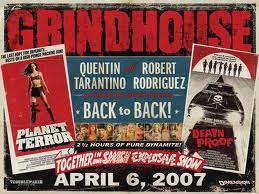
Movie Review: "Grindhouse" by David Pretty

 
Honestly, I'm not sure why Grindhouse wasn't a bigger hit.  Although the theatrical release was slightly truncated, its one-hundred-and-seventy-minute run time was probably still a bit daunting for most  people.  Not to mention the fact that Tarantino and Rodriguez asked us to abandon a set of characters at the mid-way point and get familiar with a completely new cast, not once...but twice!

But even during my first viewing, I really didn't have any major issue with this.  Probably because both segments were directed with tasteless verve, populated with over-the top performances and filled with the trappings of a long-extinct theater-going experience.

It's a philosophy which comes through loud n' clear in the trailer:


The first half of the film is dedicated to Planet Terror, a gruesome ode to zombie flicks directed by Robert Rodriguez.  Smokin'-hot Rose McGowan plays Cherry Darling, a strip...er, go-go dancer who walks off the job in hopes of finding bigger and better things.  Well, she certainly get her fill of the former after she reunites with her mysterious ex El Wray (Freddy Rodriguez) at a dodgy barbecue joint owned by Jeff Fahey's less-then hygienic J.T.

Unbeknownst to our unlikely protagonists, another drama is unfolding at a nearby military base.  Certifiably bonkers Lt. Muldoon (Bruce Willis) is attempting to extort a biochemical weapon from scientist Abby (Naveen Andrews), who deliberately releases the stuff into the air rather then hand it over.  Needless to say, this noxious gas (codenamed "Project Terror") causes residents in the nearby town to transmogrify into pox-laden homicidal zombies.  Eventually El Wray and Cherry form a posse to investigate the military base and put a stop to the outbreak.


Planet Terror is so completely over the top that it's critically outta sight.  The performances are beyond broad and there's never any doubt as to whether or not someone is good or evil.  The nature of the infection gives Rodriguez free reign to go completely overboard with buckets of creatively depraved splatter effects.  Of particular note is the humorously unexpected fate of Abby and the drawn n' quartered demise of Tom Savini's character, Deputy Tolo.

Although very little screen time is dedicated to the genesis of the lethal gas or why it's being fought over so rabidly, it effectively serves as the film's raison d'eeccch-tre.  The cast looks like they're having an absolute blast with the complete lack of restraint.  Although there's a hint of self-consciousness in her performance, Rose McGowan is charmingly matter-of-fact and unpretentious.  When she gets tricked out with her ludicrous-yet-iconic sidearm (sideleg?) she instantly fulfills one of the more original character arcs in cinema history. 


Freddy Rodriguez is appropriately cocky as El Wray and when his secret skills are revealed (and conveniently left unexplained thanks to a timely "missing reel") he gleefully transforms into walking dynamite.  Josh Brolin also makes the best of his limited screen time by playing Dr. William Block as the sort of ogre only found within the pages of an E.C. horror comic.  Marley Shelton turns in a bravura and twitchy performance as Block's long-suffering wife, especially when her own anesthetics get turned against her.  Finally, one of my all-time favorite character actors, Michael Biehn, gets a chance to shine as J.T's estranged brother, Sheriff Hague.  Why this dude isn't picking up more checks is beyond me.

All told, Planet Terror is a no-hold's barred, pulpy, splatterfest that really embodies the grindhouse aesthetic while playing around with its conventions.

In some ways, Tarantino's segment isn't quite as loyal to the genre's low-brow origins but I think it ends up being a more original, substantial and rewarding film because of it.  Death Proof begins by  introducing us to three fun-loving gals: celebrity D.J. "Jungle" Julia Lucai (Sydney Tamiia Poitier) and her two pals Shanna (Jordan Ladd) and Arlene (Vanessa Ferlito).  They venture out to their favorite bar in Austin, Texas on Julia's birthday, unaware that they're being stalked by a psychotic stuntman named Mike (Kurt Russell).


Mike is a mentally damaged relic from another epoch who's gone completely off the deep end because everyone's too young to appreciate his glory days.  He's challenged all of this rancor into the construction of a "death proof" car which keeps him safe during a crash but spells certain doom for passengers or anyone else in his path.  This is soundly demonstrated when Mike kills poor Pam (Rose McGowan) and then murders the other girls in a deliberate head-on collision.

Fast forward a year later and it looks like history is about to repeat itself.  Mike and his reconstituted vehicle are set to target four new girls: chatty Abernathy (Rosario Dawson), cute-but-dim Lee (Mary Elizabeth Winstead), non-nonsense Kim (Tracie Thoms) and thrill-seeking Zoë (Zoë Bell).  Mike confronts the gals during a muscle car endurance test but soon realizes that he's bitten off more then he can chew.


Soon the hunter becomes the hunted.  Honestly, it's quite gratifying to watch Mike start whining like a weepy little bitch after the gals prove to be too much for him to handle. Their final revenge becomes the stuff of giddy triumph.

Although Death Proof's pedigree is pretty lowbrow, Tarantino can't resist investing in markedly distinct characterizations, top-notch performances and snappin' dialogue.  As a result, the film rises above its superficial origins and becomes more than just the sum of its parts.


Tarantino really tests the viewer's patience by killing his first cast of protagonists half way through the segment.  By investing so much time and effort in characters that he's willing to casually snuff out, Tarantino evokes shades of Janet Leigh's fate in Psycho.  When he introduces us to four new gals we can't help but wonder if they'll meet a similar fate.  So, when they begin to fight back against Mike's assault, we can't help but root for their deliverance.

We all know that Tarantino is adept at characterization, performance, dialogue and set-ups but did anyone anticipate that Death Proof would include a car chase that belongs in the same hallowed pantheon as The French Connection, The Italian Job or Ronin?  All I can say is "wow".  Thanks in large part to the heroic efforts of real-life stunt woman Zoë Bell (who spends most of her screen time splayed out on the bonnet of an out-of-control 1970 Dodge Challenger), the scene is high-octane, nail-biting and rife with a genuine sense of jeopardy.


As if the two main "features" don't serve up enough entertainment value, both come fully loaded with a slew of vintage trappings.  Intermissioned with fake "previews of coming attractions" (my personal favorite: Eli Roth's Thanksgiving), title cards pimping sketchy mexican food and a slinky animated panther warning us that what we're about to see is "restricted", Grindhouse reminds us of sneaking into the cinema as kids.

Which brings me to my main praise: watching Grindhouse makes you feel as if you're getting away with something.  Leave it to nostalgia custodians Rodriguez and Tarantino for recognizing the appeal of this and following through on their vision; esoteric and niche as it may be.


      Tilt: up.

Friday, October 5, 2012

Movie Review: "Videodrome" by David Pretty

 
You certainly can't accuse oddball Canadian auteur David Cronenberg of being conventional.  As bizarre as his Videodrome may be, it's still an oddly prophetic film.  Unfortunately it's also a very uneven movie that harms its own message with a heavy dollop of pretention and a needlessly convoluted finale. 

Before we begin to examine the New Flesh in some detail, here's the film's appropriately "WTF?!?!"-style trailer:


James Woods plays Max Renn, a scummy television exec who's constantly on the prowl for sleazy and sensationalistic programs which he can serve up to the undescriminating masses.  When the station's resident tech-head Harlan (Peter Dvorsky) unscrambles a bizarre signal featuring mindless S&M-style sex and violence, Max is officially intrigued.

During his investigation, he meets whack-a-doo radio advice therapist Nicki Brand (Debbie Harry).  Instead of being repulsed by Max's proclivities, she actively seeks to "audition" for the repellent show.  Soon Max discovers that the program, dubbed "Videodrome", is very real indeed and the mere act of watching it give threatens the viewer with physical changes and terrifying hallucinations.  By the time the sinister origin of the transmission is revealed, Max has been reduced to the role of a "video assassin", programmed to eliminate anyone who seeks to expose the conspiracy.
  
 
As I said before, there's a lot to admire here.  Max doesn't a give a shit about the negative impact that Videodrome might have on potential viewers.  He doesn't care that the show's content will do nothing whatsoever to improve our world.  He just knows people won't be able to resist watching it and he'll probably make a fast buck.  This description of Max also goes for just about every single modern-day reality show producer.
 
The performances are universally solid.  James Woods does his usual awesome job playing sweaty and frantic, but he's also quite proficient at tamping down his humanity when the Videodrome signal begins to dominate him.  Debbie Harry is also a pleasant suprise as Nicki Brand and it's a shame that she relegated to such a small role in the film.  Peter Dvorsky is also effectively shlubby and infuriating as Max's dodgy pal Harlan.  

 
But perhaps the film's most intriguing character is Brian O'Blivion, played by Jack Creley.  He's sort of a Marshall McLuhan-style media prophet who believes that a public existence on television is actually more "real" then private reality.  His philosophies are surprisingly deep for what some viewers might expect from a "horror" film.

In a scene that either reveals Cronenberg's naive views towards television or his incredibly cheeky sense of humor, Max visits O'Blivion's "Cathode Ray Mission", a homeless shelter designed to rehabilitate transients via life-giving servings of video.  When Max gamely asks O'Blivion's daughter Bianca (Sonja Smits) if she thinks T.V. can help these people she replies without a hint of irony that "Watching T.V. will help patch them back into the world's mixing board".

When Smits subsequently refers to Max's appearance as his "view" and her role as her father's "screen" in a starchy upper-Canadian accent, you quickly realize that her character could only exist in the confines of a David  Cronenberg script.  Or the local booby hatch.  

 
Cronenberg keeps things grounded in reality by shooting his cluttered, lived-in environs and disheveled-looking actors under the harshest possible lighting conditions.  Everyone seems to have a chronic smoking habit and a really dreadful complexion while Max's apartment looks as if it should have an exterminator on permanent stand-by.  Even after things become decidedly Dali-esque, the director's "warts and all" approach helps to keep things looking authentic and feeling off-kilter.

Max's discovery of Videodrome and its slow reveal makes for some pretty creepy and compulsory viewing.  Rick Baker's fantastic practical makeup effects help to further this considerably.  The surreal manipulations inflicted on Max's body by the Videodrome images are as harrowing as they are convincing.  The grand-guignol comes when Max shoots one of the conspirators with a biomechanical "cancer gun", causing tumors to explode from his victim from the inside out.  Yarf.  

 
I just wish that the laser-like focus of the film's first half could have been sustained throughout the entire picture.  By the time a villainous manufacturer of eyeglasses named Barry Convex (!) shows up, Cronenberg throws all subtlety out the window and begins to drift into the realm of pretension.  And then we get the final, cryptic denouement which is the equivalent of an alternative band including seven minutes worth of feedback on their major label debut just to convince fans that they're still "indie".  

This is a real shame, because the film's main conspiracy and central themes are actually quite brilliant.  At the heart of this is our weakness as human beings.  Max knows that everything about Videodrome is wrong, but he's still too weak to resist it.  When he breaks down and watches it, the signal gives him a brain tumor that starts triggering hallucinations.

He envisions himself indulging in hideous displays of violence.  He has an extended make-out session with the boob tube (literally).  He develops a vulva-like slit in his abdomen into which pulsating Betamax instructional tapes can be inserted.  By the end of the movie, he's physically transformed into a delivery system for the very same destructive message that warped his mind, body and soul in the first place.

 
Every time someone tries to get me to watch an episode of Big Brother I can't help but feel as if they've got a lot common with Max Renn.  Despite Videodrome's failings, its central message is still sound and relevent, which is more then I can say for most thirty year old films.


      Tilt: up.


Sunday, September 30, 2012

E.T. Roundtable - Episode Two: "These Are Some Of Our Favorite Things"

"Heavens, that young man used profanity!"

By way of introduction, four-fifths of the E.T. crew yammer on about their favorite movies, television shows, comics, novels and albums!


Bonus update!  E.T. charter member Mike talks about his favorite movie, book, album and T.V. show!


Friday, September 28, 2012

Movie Review: "Star Trek: The Motion Picture" by David Pretty


After playing a game of Star Trek: Fleet Captains recently, I felt compelled to revisit the venerable sci-fi franchise's motion picture debut.  Prior to 1979, re-runs of the original series became a tremendous hit in syndication and towards the end of the decade a new Phase II television show featuring most of the original cast was in development.

But when Star Wars exploded on the big screen in 1977, Paramount decided to parley it's very own "spacey" property into a big-budgeted movie.  The final product seems to betray this disjointed genesis since it often feels like an hour-long concept dragged out over a hundred and forty-five minutes.

Here's the film's groovy, vintage trailer:


This time I made a point of watching the "Director's Edition" and it did come off as slightly improved.  Although the original theatrical release is often referred to as Star Trek: The (Slo-)Motion Picture, this re-edit seems to hang together a lot better.

Veteran genre director Robert Wise, who helmed the 1951 sci-fi classic The Day the Earth Stood Still, seems a bit tentative in his treatment of these famous characters.  It's as if their ten year hiatus has made them somewhat precious and above any rough treatment.

On the rare occasion in which the actors are actually granted a line of dialogue, the performances are actually quite decent.  Stephen Collins is a great new addition, despite having only a few fleeting moments to make his character three-dimensional.  And although the late Persis Khambatta was certainly one of the most beautiful women to ever grace the Star Trek universe, she also gets short shift before the script downgrades her to "automaton" status.

Realizing that the dynamic between Kirk, Spock and McCoy was the bread and butter of the original series, this "Director's Edition" mercifully re-instates additional scenes featuring the iconic trio.  Unfortunately, when they aren't on screen together we're subjected to endless reaction shots and protracted clips of special effects porn.

Leisure wear...IN SPAAAAACE!!!

From a design standpoint, the film is also mixed bag.  The refurbished Enterprise is definitely my favorite iteration of the classic vessel, the new Klingons look absolutely awesome, the effects are reasonably good for a thirty (!) year old film and Jerry Goldsmith's classic, robust score is rousing and unforgettable.

Unfortunately the same thing can be said about the costumes, but not in a good way.  Indeed, those woefully dated Starfleet uniforms make the film look like some sort of bizarre interstellar slumber party.  A really priceless moment of Seventies kitch occurs when McCoy, replete with Unibomber beard, pimp necklace, leisure suit and a belt buckle big enough to degrade the ship's orbit, beams back onboard in his characteristically cranky fashion.

Having said that, the film is true to the spirit of the original series, especially after V'Ger's origin is revealed in a clever twist.  As a viewer, however, it's hard not to think that the concept would have been much better served in half the run time.

"Blue screen...the Final Frontier!"

Although it's certainly flawed, Star Trek: The Motion Picture holds a lot of retro fascination for me, probably because it's one of the first films I remember seeing in the theater by myself.  I know it sounds kinda kooky, but with every subsequent viewing I find myself liking this film more and more and liking the recent "space operatic" Abrams re-boot less and less.  

 
             Tilt: up.

Tuesday, September 18, 2012

Movie Review: "Grabbers" by David Pretty

*** Special Sneak Peak Advanced Review ***


Although some folks might argue that there's no such thing as an original idea anymore, sometimes all it takes is a different perspective.  For example, Edgar Wright, Simon Pegg and Nick Frost set a horde of criminally overused zombies on weaponless, suburban London and the result was transcendental.  Some talented Swedes refashioned a bunch of hoary old vampire tropes into the wildly inventive Let the Right One In.  And now we get Grabbers, which takes a stereotypical bug-eyed monster from space and drops it smack-dab into the middle of a sleepy Irish town on a remote island.


The film's opening shot tracks what appears to be a meteor as it shears into Earth's atmosphere and splashes down just off the coast of Northern Ireland.  This is witnessed by a local fishing trawler which makes the ill-conceived decision to investigate.  As it turns out, the projectile contains something alive, mean-spirited and decidedly...grabby and it soon makes short work of the ship's crew.

Soon an entire pod of pilot whales washes up dead on a nearby beach.  These odd occurrences draw the attention of habitually intoxicated local Garda Ciarán O'Shea (Richard Coyle), his new by-the-book partner Lisa Nolan (Ruth Bradley) and marine biologist Dr. Smith (played by Being Human alum Russell Tovey).  When a local fisherman and professional barfly named Paddy (Lalor Roddy) is inexplicably spared by the creature, our heroes speculate that their otherworldly opponent is deathly allergic to the the taste of pickled villager.


Fearful of an island-wide panic, O'Shea, Nolan and Smith propose a simple and amicable defense: gather everyone together at the local pub for a good bit of crack.  No, not that kind of crack, I'm talking about craic: a rip-roaring communal drunk which will keep everyone blissfully preoccupied whilst rendering them completely unpalatable to the aliens.

Director Jon Wright does an admirable job balancing the humor with the horror.  An extended alien POV curb stomp sequence is riotously funny as is a scene in which our heroes try to get the jump on a creepy-crawly while armed with some spectacularly inept weapons.  This is nicely contrasted with a harrowing and claustrophobic squeeze though a maze of low-tide sea caves and the genuinely loathsome sight of a massive, roiling ball of tentacles bearing down on its slow-moving victim.

Wright also has the luxury of capturing some truly fantastic scenery.  Shot in County Donegal in Northern Ireland, the film is rife with beautiful pastel skies, gorgeous beaches, cool rock formations, majestic cliffs and serpentine roads snaking through treeless hills.  The interiors are also stellar, with Smith's lab, Paddy's hovel and Maher's Pub all looking gloriously practical and lived-in.  All of these unpretentious settings really helps to offset the sometimes-surreal nature of the alien threat.


Speak of the (Denebian Slime) Devil, I really loved the pulpy, slimy, Lovecraftian design of the Grabbers themselves.  Although some of the CGI is a bit creaky at times, the crew does a phenomenal job integrating their creations into cinematic "reality".  For example, when a horde of larval-stage beasties infiltrates the pub, the effects team use a series of in-camera set gags to show the ravages of their digital infestation.  It's so gloriously cartoonish that it conjures up shades of Who Framed Roger Rabbit and Gremlins.

Although the film's set up is a tad "color by numbers", the natural performances and salty dialogue really kept me entertained before the main event.  By the time the entire cast is shit-faced, the movie's entertainment value blasts into hyperspace.  This wildly original premise comes pre-loaded with so much comedic potential that you have to wonder why no-one's thought of it before.

Although some people might bellyache about "pointless" story diversions, but I really didn't detect anything particularly egregious.  Although I'd concur that the relationship between Ciarán and Lisa flirts dangerously with convention, I also appreciate that screenwriter Kevin Lehane went through the trouble of giving them backstories and fleshing their characters out a bit.  Most films of this ilk wouldn't even have bothered.


Despite a litany of conventions, the script gets a lot more right then wrong.  I really loved how the character's well-laid plans always seemed to implode.  A makeshift flame thrower completely fizzles.  Lisa's drunken attempt to retrieve the car keys from the bar results in even more peril.  Even the final scheme to destroy the Big Bad goes straight down the tubes.  Anytime a film makes a concerted effort to defy audience expectations you can be sure that I'll be there to recognize.  

A lot of the dialogue sounds completely natural and there are plenty of lines which reflect a uniquely  Irish sense of humor.  I love the scene where Ciarán finally manages to communicate to the pub's owner Brian (David Pearse) just how much booze they're going to need to repel the aliens.  "We're gonna hafta tear ther arse out of her then," the bar-keep begrudgingly admits.

Regardless of how goofy things get, the cast is always there to hold things together.  Despite his character's bout with the bottle, Richard Coyle's performance as Ciarán is actually quite sober and substantial.  He's the sort of protagonist that most audience member can relate to: standing his ground when there's little alternative and making a "strategic withdrawal" whenever possible.  His sly line deliveries and casual asides command your attention while making a compelling case for repeat viewing.


Like a winsome combination of Anna Paquin, Kate Winslet and Dolores O'Riordan, Ruth Bradley has a charmingly unique presence that's all her own.  She plays buckled down and uptight so well that her booze-fueled turn in the second half is downright revelatory.  She seems so genuinely blitzed that I suspect she pulled a fast one and just took belts from a whiskey bottle between takes.  She's also fun to watch in a heroic capacity, nail-gunning a critter's gob shut and spouting lines that would make Ellen Ripley beam with pride.

Sometimes Russell Tovey can be a tad shrill and over-wrought, and this tendency creeps into her performance, especially when he's called upon to be plastered or terrified (or sometimes both!).  He's really at his best when he plays Smith as a pompous know-it-all who flirts awkwardly with Lisa.  In this capacity, Tovey makes for an effective wince-inducing goofball who's still charming enough to make the audience root for his survival.

There are plenty of memorable minor performances in the film as well.  Lalor Roddy is wonderful as the eternally-soused grizzled contrarian Paddy.  David Pearse as Brian the bar owner is amusingly skeptical at first, but becomes downright gung-ho after he's convinced that the threat is real.  Also making the most out of her screen time is the always-sassy Bronagh Gallagher (of Commitments fame), who plays Brian's wife Una.  Between her impish efforts to play matchmaker for Lisa and Ciarán and her borderline chronic skepticism, Bronagh is a real delight to watch.


One of the highest compliments that I can give to a film is that I want to see it again.  Between missing out on a joke because I was laughing so hard at the previous one, trying to pick up on a throw-away line of dialogue or sifting through the occasional brogue-heavy delivery, I would love to see Grabbers again.  I'm willing to wager that the tiny scraps that got by me here are more entertaining then what's  served up in your average creatively destitute Hollywood horror flick.


 Tilt: up.


P.S. Grabbers is set for a wide release in the latter half of 2012.

Tuesday, September 11, 2012

Movie Review: "Tron" by David Pretty


Personal computers came of age in the 1980's and with these wondrous, new-fangled devices infiltrating our homes it was just a matter of time before we began to speculate about what was going on amidst those micro-chip-studded motherboard landscapes.  

Since Tron, at face value, appeared to be the geekiest movie ever made, I felt compelled to see it in the theater as a twelve-year-old kid.  Unfortunately it was also one the first times I can distinctly remember saying "M'eh" when someone asked me what I thought of it.  After re-visiting Tron again recently, I've come to realize that the film feels half-baked mainly because the technology of the time just couldn't do justice to its ambitious premise.


Jeff Bridges is Flynn, a brilliant computer programmer who's ideas have been pilfered by the unscrupulous tech czar Ed Dillinger (David Warner).  This blatant thievery has allowed Dillinger to climb to the highest rung of ENCOM's corporate ladder and have Flynn purged from the payroll.  To vindicate himself, Flynn hacks into the company's mainframe and tries to dig up some evidence of Dillinger's duplicity but his avatar is captured and de-rezzed by the now-sentient Master Control Program.

The resulting security lockdown effects two other ENCOM employees: Alan Bradley (Bruce Boxleitner) and Dr. Lora Baines (Cindy Morgan).  They conspire with Flynn to activate "TRON", Alan's security program in an effort to destroy the MCP's stranglehold on their virtual world.  In doing so, Flynn is digitized and electronically transplanted onto the grid where he's forced to participate in various gladiatorial-style video games.  With the aid of Alan's Tron and Lora's virtual identity Yori, they break free of the game world and trek across the electronic landscape to confront the MCP and Dillinger's codified doppelganger Sark.  


If all of this sounds dense, impenetrable and, to a certain extent, pointless, I'm afraid you've stumbled upon Tron's greatest weakness.  With only a few "blink and you'll miss it" scenes with the MCP asking Dillinger for real-world financial data (with the inference that it has it's eye on global domination), the threat is low and the stakes feel minimal.  And let's face it, movies like this are only as good as its villain.  

Jeff Bridges is a delight to watch.  Even when his face is rendered into a monochromatic haze, he's still animated and charismatic.  Bruce Boxleitner's Alan is meant to be a bit staid, but there's a huge difference between reserved and wooden.  It's also inconceivable to me that Cindy Morgan didn't become the penultimate 80's geek pinup girl, since her brainy beauty as Lora/Yori rivals that of Jan Smithers' Bailey Quarters or Erin Gray's Wilma Deering.  Regrettably she doesn't get a lot to do here except look fetching, which she easily accomplishes.  Finally, the always-awesome David Warner is coolly threatening, or as threatening as a heel can be while wearing day-glo red pajamas.


Large stretches of the film look pitifully dated.  The computer imagery is often well-designed but rendered based on the obvious limitations of the day.  Often it feels as if you're watching someone else play a bad video game and you're not allowed to push any of the buttons.  To top it off, the music is a major liability.  It's obvious that director Steven Lisberger wanted an electronic soundtrack to jibe with the film's mise-en-scene but to me it sounds like a keyboard stuck on "DEMO".

I'm actually looking forward to seeing Tron: Legacy sometime soon, mainly because contemporary visual effects and computer animation technology have finally caught up to the concept.  In theory, the 2010 sequel is a perfect film for today's tech-savvy audiences.  The original Tron, however, is mainly a cinematic oddity with an overly-ambitious concept hanging around its neck like an albatross.  It's  another film that often gets a free pass due to the sanguine effects of nostalgia.


   Tilt: down.