Tuesday, May 8, 2012

Movie Review: "The Avengers" by David Pretty


Excelsior, True Believers!

Y'know, as great as some comic book films have been, most of them have been completely devoid of one key ingredient: pure unadulterated fun.  The Avengers is Joss Whedon's learned response to this deficit, making his movie something of modern miracle.

Hell, there's more fun packed into the film's theatrical trailer then there is in the entire run time of most summer blockbusters...


When I first heard about an Avengers movie I really didn't think that it would work.  My biggest fear was that it would end up like a superhero version of House of Frankenstein; I.E too much of a good thing.  Besides, how could they possibly hope to convince all of these A-list actors to willingly share the marquee?   How could the screenwriters possibly come up with a suitably epic crisis?  How could all of these characters co-exist in the same space together without rending apart the very fabric of our universe?

But when I heard that Joss Whedon was tapped to write and direct ssuddenly all fears were allayed.

"Okay, Scarlett in this scene you bludgeon an A.I.M. agent to death with a DVD copy of Home Alone 3."

Back in the Dark Ages, the only qualification that a prospective comic book movie director had to posses was the ability to be "visual".  After they were hired, these film-makers would go out of their way to tell everyone within earshot that they were "fans" of the funny book in question when they were kids.  Then they'd unerringly deliver a final product that completely changed or virtually eliminated everything in the comic that they supposedly loved.

In the next epoch of comic book movie evolution, accomplished film-makers such as Chris Nolan, Bryan Singer and Matthew Vaughn were handed the ball.  What these guys lacked in encyclopedic comic book knowledge they more then made up for it in their rare and valuable ability to capture and quantify the spirit of the original source material.

"Avengers...togetherfy!"

But in Joss Whedon, fans have finally gotten The Perfect Storm.  Not only is he a bona-fide, died-in-the-wool, card-carrying comic book geek, he's actually written a few that are considered modern classics of the medium.  If anything, the pendulum has completely flipped the other way.  Going into The Avengers I was concerned that Whedon might not be able to deliver a visually striking film.

I am sorry that I ever doubted you, My Liege.  Even if it was but for a mere moment of personal failing...  


Oh, whoops.  Did I just type that?  I was only supposed to think it.

With plenty of geeky plot points lovingly seeded in previous Marvel films, story masters Whedon and Zak Penn seem to be relishing the harvest.  Anyone who's followed Joss's serialized works in the past (like Buffy, Angel and Firefly) knows that he's a huge sucker for continuity and The Avengers is no exception.  Whedon's solo-penned screenplay is the clarion voice of one talented writer who actually knows how to make a complicated celluloid juggling act pay off.

"Honestly, Sam, with Kinect bowling it's all about the follow-through." 

The first hint of Marvel Universe cross-pollination occurred in 2008 as a post-credit sequence in Jon Favreau's excellent adaptation of Iron Man.  In this brief segment we're introduced to Nick Fury (Samuel L. Jackson) the no-nonsense director of a shadowy espionage team known as S.H.I.E.L.D.  Fury infiltrates the office of Tony Stark (Robert Downey Jr.), deflates his ego by telling him that he "isn't the only superhero in the world" and then broaches the tantalizing subject of the "Avenger's Initiative".   Hmmmmmmm...

This was nudged along in a follow-up segment which came at the end of The Incredible Hulk in 2008. After watching Bruce Banner (Ed Norton) achieve some semblance of control over his dark side, we're then privy to a meeting between Tony Stark and disgraced Hulk-hunter General Ross (William Hurt).  Stark tells him that "we're putting a team together", presumably to keep tabs on a certain emerald-hued rage monster.  

"MUST...FIRE...AGENT!!!"

Then Iron Man 2 gave us another interesting story element that Whedon effortlessly managed to weave into The Avengers.  Inspired by his father's legacy, Tony Stark discovers a new element and then finds himself on the verge of developing a clean and fully-sustainable form of energy.  We were also introduced to the beautiful but deadly Black Widow (Scarlett Johansson) whom Fury had tasked to gage Stark's ability to work and play well with others.

In last year's Captain America, the diabolical Red Skull was using a mysterious artifact known as the Tesseract (née the Cosmic Cube) to create an arsenal of advanced weapons.  When Cap (Chris Evans) was plopped into the arctic ocean at the climax of his eponymous film, the cube was lost with him.  Tony Stark's pop Howard manages to recover the Tesseract, which proves to be the optimal Duracell battery for his sustainable energy project.

"Hey, what did you mean by 'spangly'?" 

Finally, at the climax of Thor, the Thunder God's half-brother Loki (Tom Hiddleston) was laid low and cast down into the Abyss.  A post-credits sequence in that film showed Fury tasking Dr. Erik Selvig (Stellan Skarsgård) with tapping into the "unlimited power" of the Tesseract.  In a sly cinematic moment there's a quick glimpse of Loki's reflexion in the background, clearly indicating that the Asgardian's corrupting influence will soon be felt.

Let's face it folks, there's nothing more comic booky then a series of epic cross-overs.  I don't know who first proposed this brilliant idea but he or she deserves to get a free island in the Caymans this year as a Christmas bonus.  Whedon, a recreational fan of Marvel Lore, not only manages to tie all of this together, he makes it pay off in spades.

In doing so, he single-handedly neuters every argument that the Star Wars prequels weren't supremely shitty after all, just a victim of over-hype.  The Avengers proves, beyond a shadow of a doubt, that in the hands of a smart and well-invested creative team, a film can not only meet expectations but completely trump them.

With the unearthly success of The Avengers, will geeks lose their best kept secret to Hollywood forever?  

True to the post-credit tidbits, Loki has indeed been restored to full form by the leader of an aggressive alien race known as the Chitauri.  In exchange for his liberation, the mysterious Other demands that the God of Mischief recover the Tesseract.  The Other has pledged an entire army towards Loki's goal of subjugating the Earth should he succeed in this.

The Tesseract proves to be too volatile for S.H.I.E.L.D.'s scientists to handle and Loki soon emerges from a portal created by the cube.  After placing Selvig and the uncanny archer Hawkeye (Jeremy Renner) under his thrall, Loki absconds with the Tesseract just as the S.H.I.E.L.D. base turns into a Sunnydale-style sinkhole.

TOTALLY METAL

Knowing that it's only a matter of time before Loki taps into the power of the Tesseract, there's a call to assemble the Avengers.  Thor (Chris Hemsworth) is immediately drawn to the dark machinations of his step-brother, the Black Widow is dispatched to India pull Dr. Bruce Banner (Mark Ruffalo) out of hiding, utility Agent Coulson (Robert Clark Gregg) gives Tony Stark a homework assignment and Nick Fury tries to coax the recently-defrosted Captain America (Chris Evans) back into action.

Needless to say things don't go according to plan.  If I didn't know any better I'd swear that Whedon actually used the film's potential pitfalls as story fodder.  Captain America is instantly rankled by Iron Man's cocky selfishness, Iron Man shows open contempt for Cap's antiquated and mindless "do or die" attitude, Bruce Banner is immediately wary of Fury's motivations, the Black Widow catches heat for being a S.H.I.E.L.D. attack dog and Thor resents human intervention in what he sees as a domestic dispute.  Oh, and he's also completely preoccupied with baiting the Hulk.   

"Methinks I can take him."

Since I believe that people who deal in spoilers should be Dragon Punched right in the Danger Zone, you'll get no more plot points out of me.  I'll just allude to some of the awesome things which will have any self-respecting comic book geek giggling like a pleased infant...
  • As soon as I laid eyes on the Other, I was impressed that Whedon had tapped such an obscure but powerful villain.  Bravo, sir.    
  • Apparently Tony Stark and I share similar taste in music.
  • Shell-head vs. Goldilocks.  'Nuff said.
  • Coulson's card collection.
  • Whedon finally answers the question: "So, what would happen if Thor smoked Captain America right in the...shield?"          
  • Galaga
  • Jane Foster's cameo via headshot.  
  • "'Monkeys'.  I understood that reference!"  
  • Even when facing off against Asgardians, Cap's faith is unshakable.  
  • The Hulk's impersonation of Bamm-Bamm.  And his subsequent line
  • Shawarma.
  • Tony Stark compares Thor to Bodhi.
  • Cap's bet with Nick Fury.
  • The Black Widow being "interrogated". 
  • The sucker punch to end all sucker punches.
  • Cap's old-fashioned nosiness beats modern technology.
  • Three partial words: Heli-fucking-carrier.
  • "You people are so petty...and tiny."
  • Thor's comeback to the Black Widow RE: bad apple Loki.
  • Cap's key to giving orders to the Hulk: Keep It Simple Stupid.  
  • Tony's theory on how Banner's been staying so "mellow". 
  • "Ladies and gentlemen, the dotty genius of Harry Dean Stanton." 
  • Iron Man's line to Hawkeye just prior to blast-off.
  • Stan Lee's obligatory cameo.
  • Loki catches major heat from Hawkeye.
  • The Hulk's tremendous catch.
  • Tony's paranoia about being molested while unconscious.
"Mr. Force, I'd like for you to meet someone..."

And honestly, people, I've just scratched the surface.

I loved Whedon's theatrical Firefly capper Serenity, but for a sci-fi film it really didn't have a particularly gregarious visual style.  This isn't the case with The Avengers.  The action scenes pulse with dynamic life.  Except for a briefly zoomed-in but kinetic melee between Thor and Loki, things are shot at a distance, allowing the audience to easily follow the scale and logistics of the battles.  The film also features some crackerjack editing by Jeffrey Ford and Lisa Lassek.

"You take the fourteen thousand on the left..."

Whedon also comes up with some genius set-ups.  I loved the flippy exploding car-cam, the image of the heroes reflected in a discarded rear view mirror and the amazing continuous shot of Cap charging up the alien-ravaged streets of New York City like he's storming the beaches of Normandy.

But it's the cast that makes The Avengers truly transcendent.  Once again Robert Downey Jr.'s Tony Stark is exactly what you'd expect of a self-professed "genius, billionaire, playboy, and philanthropist".  He's a gleefully manic wiseass motor-mouth who always seems three steps ahead of everyone else.  But of all the characters, it's Iron Man who experiences the most dramatic arc after exposure to the group dynamic.  Faced with the realization that he no longer holds a monopoly on being "super", Tony experiences a genuine epiphany here.

"Truth be told, my favorite Sabbath song is actually 'The Wizard'."  

At the conclusion of Captain America, Steve Rogers was trying to come to grips with his Rip Van Winkle syndrome.  In The Avengers, Chris Evans really gets a chance to run with this and for an ensemble ("Assemble?") piece his character development is considerable.  Cap starts the film as morose and dispossessed, only scoring small victories when he succeeds at understanding a modern reference.

But as the story advances, his place amongst the technological marvels, demi-gods and invulnerable Goliaths starts to come into focus.  As powerful as the Avengers are individually, none of them really possess any tactical skill.  There's a tremendous moment late in the film when everyone just realizes that Cap is the best possible leader for the group.  When this happens, you can almost see Evans shed his invisible chains and come alive.

"C'mon, guys, how 'bout a sing along?  I assume everyone knows the words to 'Camptown Races'?"

Since I'm also a huge continuity junky, I would love to have seen Ed Norton reprise his role as Bruce Banner.  Unfortunately, contract talks broke down between the actor and the studio, precluding his involvement in The Avengers.  The good news is, the producers managed to procure the incredible talents of Mark Ruffalo.

In order to assimilate the character, Ruffalo has come up with something really special here.  His line readings are coiled and eccentric, his appearance is appropriately threadbare, and his body language screams "powder keg".  When Loki's divisive influence begins to gnaw at him, Ruffallo single-handedly generates an aura of impending catastrophe.  This is pretty remarkable, considering that that the room is also garrisoned by a deity.

"Actually, you probably wouldn't even like me when I'm vaguely inconvenienced."

Speak of the devil, let's just come out and say this right now: Chris Hemsworth is Thor.  Say what you want about him cruising on his physical suitability or appropriately Asgardian delivery, the dude is also a good nuts- n'-bolts actor who can effortlessly portray the otherworldly bearing of a Thunder God.  In The Avengers, Hemsworth's Thor assumes the mantle of guilt that Loki is incapable of.  His inability to make his half-brother do the right thing comes out in palpable waves of frustration.

Hiddleston himself is also fantastic: duplicitous, silver-tongued and supremely full of himself.  Any villain that gets cheered after being slammed around so much is obviously doing something right.  Honestly, Hiddleson is so much fun to watch that he largely dismantles my main gripe about the film, which is the been there, done that quality of the invading threat.

"Verily, am I not beautiful?"

I'm very pleased to see an expanded role for Scarlett Johansson.  In addition to exploring the more intriguing facets of Black Widow's troubled headspace and rocky past, Scarlett (and her vastly unsung stunt double) go to great lengths to serve up some stellar action beats.  If it's been your cinematic wish to watch a hot girl beat up a goon while strapped to a chair then run, don't walk, to see The Avengers.

The highly-adept Jeremy Renner rounds out the Avenger's roster as archer-supreme Hawkeye.  Due to the nature of the story, his character is the only one who gets a bit shortchanged.  Whedon rewards Renner's early function as an automaton by giving him a slew of bad-ass lines and some meaningful moments with Scarlett Johansson in the second half of the film.  The scene in which the two ponder their checkered past and current roles as human projectiles is particularly noteworthy.

"Mockingbird!?!?  Really?!?!"

The supporting cast also contributes to the film's equation of awesome.  Samuel L. Jackson plays Nick Fury to crankily exasperated perfection.  He's toned down his trademark bombast in lieu of a more sober bearing, like a man who truly has the weight of the world on his shoulders.  He comes across as refreshingly disarmed in the sequence where he's confronted by Cap.

Also we've come a long way with Agent Phil Coulson, having seen him in almost every Marvel film since 2008.  Clark Gregg has always had tremendous fun with this part, portraying the fed as a disarmingly witty, yet subtly intimidating man-child.  His scenes with Robert Downey Jr., Gweneth Paltrow and Chris Evans are banter-iffic.  In many ways, Coulson is the audience, trying his damnedest to remain cool and authoritative while a riot of imaginative insanity runs wild all around him.

"Alas, friend Coulson, even the Odinson hath failed to best thine score in yon archaic shooter."

And say what you want about Gweneth Paltrow's sometimes-bizarre Martha Stewart-style peccadilloes, I still love her for doing a cameo here as Pepper Potts.  Honestly, I think that she's just adorable.  So good is her chemistry with Robert Downey Jr. that I hereby insist that she divorce Chris Martin and marry Robert Downey Jr. post haste.  It just makes more sense to me.

And as if How I Met Your Mother didn't give me enough incentive, B.C.-born Cobie Smulders is totally going on my list.  She's authoritative, gung-ho and inordinately sexy while running around, shouting orders, firing guns and rockin' a skin-tight blue bodysuit like nobody's bidness.  What can I say, I'm a fan of any gal who's name is weirder then my own.

She's thinkin' about me in this photo.  I can tell.  

Like any good comic book, the script for The Avengers actually tackles a few real-world issues.  Stark's interest in sustainable energy feels ripped right from the headlines.  The decidedly hawkish theory of insuring personal, national and global security through overt weaponization is particularly timely.  Themes of teamwork, loyalty and self-sacrifice abound.  All of this gives your brain something to munch on, even as we thrill to the visceral sight of the Hulk punching out a giant, flying bio-mechanical eel.  In many ways, The Avengers is kinda like a post-Transformers palate-cleanser.

Yes, there's definitely a point when an endless salvo of sound and fury gets fired at us.  But because Whedon and company have invested in the characters, theme and story so much, we don't become numb to the spectacle.  The experience never feels hollow.  

Above all, The Avengers proves beyond a shadow of a doubt that a comic book movie doesn't have to be "dark" in order to be good.  More then any of his predecessors, Whedon truly displays a fundamental grasp on what makes the four-color medium work.

Turns out all you have to do is make your characters real, pack some relevant issues underneath the hood and come up with a genuine reason to fight even before someone throws a single punch.  


Tilt: up.

Friday, May 4, 2012

Movie Review: "Iron Man 2" by David Pretty


Iron Man 2 does something that isn't always a given when it comes to sequels: it doesn't embarrass itself.  Conversely it also doesn't distinguish itself a whole lot.

Here's the film's trailer, which I'd promptly like to have stricken from the record since it looks awesome and, as such, is completely counter-intuitive to my argument.  


The follow up to 2008's triumphant super-hero opus sees our hero Tony Stark (Robert Downey Jr.) dealing with a slew of new variables.  Elements within the U.S. Government are growing increasingly twitchy that a self-indulgent, egotistical playboy is in sole custody of the Iron Man armor.  A rival industrialist named Justin Hammer (Sam Rockwell) is trying to accelerate and commercialize the same technology.  A psychotic super-villain calling himself Whiplash (Mickey Rourke) comes out of the woodwork with a grudge against the Stark name.  As if that wasn't enough, Tony discovers that he's slowly being killed by the the very same arc reactor which powers his crippled heart.

Additional wild cards come into play when Tony makes Pepper Potts (Gwyneth Paltrow) C.E.O. of Stark Industries, allows the enigmatic Natalie Rushman (Scarlett Johansson) into his inner circle, hits the bottle pretty hard during a champagne supernova birthday bash, butts heads with formal military pal James Rhodes and tries to glean the motivations of mysterious S.H.I.E.L.D. operative Nick Fury (Samuel L. Jackson). 

 
As you can see, a lot of STUFF happens in Iron Man 2 but it often plays out like a checklist of what the film-makers wanted to shoe-horn into the picture versus what should organically emerge from a well-crafted story. 
 
Jon Favreau needs to thank the casting gods every day for making Robert Downey Jr. available to him.  Even if the titular hero only appeared for five minutes at the end of the film, it would still be worth watching just to see Downey being put through his paces as Tony Stark.  His scenes with Gwyneth Paltrow are a showcase for well-delivered verbal sparring, but this is overused somewhat and threatens to become as annoying as an average episode of the Gilmore Girls.

 
In IM2 the always-awesome Don Cheadle replaces Terrence Howard as James "Rhodey" Rhodes (rumor has it that Howard rubbed director Jon Favreau the wrong way at some point).  It's likely that my lack on interest in the character here isn't due to any failing on Cheadle's part and more of a symptom of how underwritten the role seems to be.

Mickey Rourke is pretty intense as Whiplash/Ivan Vanko but his marble-mouthed deliveries and inexplicable penchant for birds seems more like the peccadilloes of a certain eccentric actor versus something that was scripted.  Scarlett Johansson makes ample use of her brief screen time and wows us with a self-assured turn and a heaping side-order of ass-kickery.

 
The real plum performance, however, comes from Sam Rockwell as the smarmy, slimy Justin Hammer.  He's portrayed a lot younger in the film versus the comics but I really don't mind this since Hammer now functions as a weaker and more ethically unsound version of Tony Stark.  Rockwell has a blast with the part and the audience also has fun counting down the seconds towards his inevitable comeuppance.

Favreau does improve on the flying sequences and manages to orchestrate some high-octane action beats as well.  The final battle is fun and dynamic but looks kind of dark and muddled.  It also feels underwhelmingly truncated; a pall that regrettably seems to hang over the rest of the film as well.

 
In fact, I can't help but feel as if large chunks of the movie were excised.  For example, promotional material exists which references a love interest for Pepper Potts and the scene in which she tosses Tony's Iron Man helmet out of the cargo plane is no-where to be seen.  It wouldn't surprise me that Favreau thought that the film was becoming too much of a product by committee and got a tad "snip-happy" in the editing bay, perhaps fearing a "too many cooks"/Spiderman 3 scenario. 

Indeed Iron Man 2 doesn't quite have the sleek look and "new armor smell" of its predecessor but the movie is still held together by the presence of Robert Downey Jr at the helm as well as its unabashed commitment to providing some genuinely geeky fun.


  Tilt: down.

Thursday, May 3, 2012

Movie Review: "Mad Max" by David Pretty


Hey, kids!  Remember when Mel Gibson was only crazy in the movies?  Yeah, sadly neither can do I, which is why I sat down recently to revisit Mad Max.   
 
There are two major actor archetypes: character actors like Gary Oldman and Billy Bob Thornton and then there are leading-man types. Like Harrison Ford and Cary Grant, Mel Gibson always seems to be riffing on variations of a certain cinema identity ... read more Now there are two types of actors out there: brave chameleons who willingly vanish inside the skin of oddball characters and leading-man types who don't like to stray very far away from playing idealized versions of themselves.  Whether it be by chance or deliberate engineering, Mel Gibson has always gravitated towards roles that depict him as noble but kind of unhinged.  Not only does this place him squarely in the latter category of actors it also serves as rich fodder for legions of armchair psychologists.  

Which begs the question: how much of this was a conscious decision on Gibson's part and how much of it was casting to type?  This sort of chicken-and-the-egg speculation occurred to me back in 2010 when Gibson attempted to resuscitate his tarnished career by starring in Edge of Darkness, playing a character not dissimilar to "Mad" Max Rockatansky.

Before proceeding down this strange and deadly highway, here's the film's scruffy-looking trailer:


Back in the mid-Seventies visionary film-makers George Miller and Byron Kennedy came up with a concept for a dystopian future that was both dynamic and reasonably cheap to realize.  Fueled by cautionary headlines about peak oil, increased lawlessness on the road and Miller's own stint in an emergency crash ward, the concepts coalesced into one of the biggest domestic hits in Australian cinema and the perfect foundation for a new sci-fi franchise. 

Set in a future only "a few years from now", Max's world is clearly beginning to collapse into a quagmire of greed and chaos.  Fuel has grown increasingly scarce and roving gangs of motorcycle-driving lunatics are terrorizing pedestrians and motorists everywhere.  The only levee standing against this tide of anarchy is a nominal, understaffed, and possibly privatized highway police unit: the Main Force Patrol. 

 
Their star player is Max Rockatansky, who manages to put public enemy number two, the so-called Nightrider, out of commission in a brutal, high-speed game of vehicular chicken.  The pendulum of the plot then swings into the realm of revenge when the gang's defacto leader, The Toecutter, seeks payback for the death of the Nightrider.  After Max's worst nightmare is realized, he struggles to hold onto his veneer of civility and sanity. 

Despite the film's microscopic budget, the costumes, props and cars all help to sell the film's low-fi vibe.  The innovative and gutsy actions sequences never cease to amaze and I can't help but ponder how many non-unionized stunt workers were maimed while shooting this.  The vehicular mutilations that occur on screen during this film really defy description. 

 
The film's skid-row aesthetics really drive home the perception that society is both morally and financially bankrupt.  Mad Max is certainly the product of a long-gone era and the film's financial challenges add to its bizarre appeal. The soundtrack is completely over the top: soft and saccharine when Max is at home with his beloved wife and brassy and anthemic during the action scenes. 

Gibson himself was only twenty three when he made Mad Max but even at that young age he's completely self assured and has "star power" written all over him.  He plays Max as a pillar of the community with staunch beliefs, who only becomes corrupted when dire circumstance and the cruelty of EVIL MEN reluctantly casts him into the realm of anti-hero. 


His on-screen wife, played by Joanne Samuel, is both winsome and feisty.  She has a fantastic rapport with Gibson, making the film's inevitable denouement all the more painful.  Knowing that he's been cast as head freak amongst a spectrum of degenerate weirdos with names like "Mudguts" and "Bubba Zanetti", Hugh Keays-Byrne goes for broke as The Toecutter.  Every time he's on-screen he's appropriately off-kilter and quietly menacing. 

Again, there isn't a lot of cash up on-screen here but there are just so many odd, cock-eyed little moments to look out for it never fails to arrest my attention. The film is also tonally schizophrenic, veering drunkenly between scenes of roadside mayhem and moments of mundane bliss as Max and his family take off for an incongruous road trip to the country. 


Anyway you cut it, Mad Max is a very odd and unique little time capsule, the angry bastard child of Australia's emerging film industry and Grindhouse-style exploitation. 


Tilt: up.
There have been a few rare but memorable instances as a film fan when I've been watching an adaptation of some fantasy property and felt a rush of giddy excitement when I realize that the director has hit a home run. It happened watching Bryan Singe... read more 

Friday, April 27, 2012

Movie Review: "The Cabin in the Woods" by David Pretty


In the interest of full disclosure, I must confess up front that I am Joss Whedon's bitch. 

Honestly, it wasn't always that way.  Back in the late 90's my infinitely smarter half tried in vain to get me to watch Buffy the Vampire Slayer.  Every time I'd glance over and catch a glimpse of Sarah Michelle Gellar wrestling with some guy wearing a facial appliance, I'd turn my nose up and say something snobbish like: "Honestly, why do you insist on watching such puerile nonsense?"

Then I'd turn back to the infinitely more mature pursuit of playing Warcraft.  Not World of Warcraft, mind you, just plain ol' vanilla Warcraft.     

Eventually a co-worker forced me to watch the pilot episode of Buffy à la Alex in Clockwork Orange.  Just as I was about to give up on it, the gloriously bitchy Cordelia Chase (played by the appropriately named Charisma Carpenter) appeared from out of nowhere, took one look at dowdy Willow Rosenberg (Alyson Hannigan) and said "Nice dress, Willow.  It's good to know you've seen the softer side of Sears".

I was working for Sears at the time.  I was also instantly converted.  

Ever since my epiphany I've worshipped without pause at the altar of all things Whedon.  Buffy, Angel, Firefly, Fray, Dollhouse, Dr. Horrible's Sing-Along Blog: I've devoured every one of the man's table scraps ravenously.   

So, needless to say, this review probably won't be the most objective thing that I've ever written.  Nevertheless, I'll do my best not to gush like an overheated fanboy.

Sooooo...the plot.  A detailed synopsis presents the first of many sticky wickets.  How can I lay the groundwork for this review without spoiling the film like a bag of milk left on a radiator for a week?

Okay, well...let's see.  Cabin In The Woods is about a rustic...dwelling...in the...woods?  

Sorry, I got nuthin'.  If there are gonna be spoilers, I'd rather they come from an officially sanctioned source like the film's theatrical trailer.  To the blissfully sheltered I say unto thee: tread carefully.


So, basically, five college students venture out to the set of The Evil Dead for a presumptive weekend of partying and casual sex.  Naturally, once they get out there, one of them finds an old diary and reads a creepy passage in Latin out loud.  This seems to rouse some terrible evil from its slumber which then proceeds to stalk and kill the interlopers one by one.  As the story unfolds, however, we begin to suspect that there's more to this age-old pantomime then meets the eye.

To reveal any more of the plot would go against the Geneva Convention's tenants concerning spoiler douchebaggery.  Honestly, the less you know about the film going into it the better.  In fact, if you're currently in possession of some sort of time-displacement device I'd heartily recommend that you go back to the point just before you watched that trailer.   

Yeah, sorry 'bout that BTW.   

Some critics believe that the film's marketing campaign reveals too much of the mystery.  I concede this point somewhat, but I also suspect that if the producers hadn't shown at least some of their hand, they'd probably have organ donors like this slack-jawed troglodyte threatening to sue them for false advertising.  

If Whedon and company had gone with a promotional campaign that only painted the film as your run-of-the-mill slasher flick, it might have been disastrous.  Discriminating movie-goers would have written the movie off as hopelessly derivative and morons who actually like hopelessly derivative would have suffered an allergic reaction to all of that pesky and confusing originality on display.

If I thought that most people out there weren't supremely stupid I certainly would have preferred a more subtle trailer that mainly showcased the murderdeathkill cabin-based hi jinx with a couple of minor tells thrown in that might only became obvious upon repeat viewings.  Hell, I think that a single glance at the fucking poster is enough to convey that something is askew here.  But unfortunately, most people have the IQ of a piece of furniture, such as the two mouth-breathers sitting behind me in the theatre who had to talk themselves through the movie as if they were coming down from a bad acid trip.

As if the trailer isn't revealing enough, the film actually kicks off with an incongruously banal conversation between two bored office workers (played by Richard Jenkins and Bradley Whitford).  Still nattering on about the challenges of child-proofing a kitchen, they emerge from their innocuous-looking break room into what appears to be a top-secret research facility.  After they're joined by a clip-board armed Amy Acker in full-on sexy scientist mode, we know that our expectations for a straight-up slasher film are going to be seriously fucked with.

This is made comically apparent when the previous scene jarringly throws to a Grindhouse-style title card and an animated credit sequence rife with dripping blood and ominous imagery.  The transition is done without any warning whatsoever and had me giggling like a kid on Christmas morning.

Screenwriting tag-team Drew Goddard and Joss Whedon then proceed to tear apart genre conventions like toddlers attacking a wall of Lego.  The "jock" gives academic advice, the "bimbo" is pre-med, the "virgin" may or may not adhere to the traditional definition of chaste and the "stoner" proves to be the most insightful character in the film.


All of this serves to sustain the viewer as Goddard and Whedon gamely trot out an entire cavalcade of scary movie clichés.  The characters encounter a creepy old gas station attendant who serves up dire warnings like a backwoods Greek chorus.  Their final destination "isn't worthy of global positioning".  The cabin itself looks Club Med for Deadites.

Almost immediately, dark machinations begin to nudge the characters towards archetypal behavior.  Curt (Chris Hemsworth) morphs into a meat-headed alpha male and Jules (Anna Hutchison) breaks the knob off the Slut-O-Meter by making out with a stuffed wolf's head (?).  Even when things start to go south, Curt's initial impulse to stick together is nullified by some intangible force.

Curt: This isn't right.
Holden: What? What's the matter?
Curt: This isn't right, we should split up. We can cover more ground that way.
Holden: Yeah. Yeah, good idea.
Marty: Really!?! 


The film then cuts back and forth between the drama going on at the cabin and the machinations happening behind the scenes.  Eventually the resilient survivors (as well as the gobsmacked audience) piece together what's going on just moments before all hell breaks loose.  Literally.     

Long-time Whedon collaborator Drew Goddard does a fantastic job in his feature-length directorial debut.  His set-ups feature dynamic motion, giving the film tremendous verve.  Many of his shots are framed in smothering levels of darkness, producing a genuine feeling of impending doom.  He also exploits the depth of frame, gleefully dropping things half-glimpsed into the background.  I particularly liked his juxtaposition between the ghoulish office party and Dana's life or death struggle being played out in the background like an ESPN highlight reel. 

And this is perhaps the film's greatest achievement.  Whereas a movie like From Dusk Til Dawn unsuccessfully tried to boilerplate horror and crime dramas together, Cabin's bait-and-switch ending actually works.  After the script trots out all of the threadbare old tropes the gleefully insane detour provided by the final reel is downright cathartic.  And even though the film pulls the equivalent of a tonal half-loop, it still manages to be more thrilling then disjointed.


In the past Whedon's more flippant, cheeky or self-referential lines have needlessly taken the piss out of dramatic moments, but for the most part the dialogue here is just plain clever.  I love it when Hadley re-assures Lin that "We know what we're doing. We have it written down somewhere" and when Marty, the film's unlikely source of wisdom, opines: "Society needs to crumble. We're all just too chicken shit to let it".  All of the character's voices are clarion, unique, and well-tailored.

Although some of the actors seem a bit long in the tooth to play college kids, this also feels strangely traditional.  Kristen Connelly's Dana is like a combination of Felicia Day and Amy Steel from Friday the 13'th Part 2.  Wilting and retiring at first, Kristen is able to display a convincing will of instinct after shit starts to get (un)real.  She even manages to capably sell Dana's turn towards pragmatic ruthlessness in the final act.

Some of the actors are essentially required to perform dual roles.  Initially self-assured, charismatic and noble, a pre-Thor Chris Hemsworth has to switch gears at the mid-way point and play Curt as an addle-brained, nerd-baiting, walking gonad.  Then, after her new hair color kicks in (you'll understand when you see it), previous Power Ranger Anna Hutchison's disposition as Jules goes from effervescent and sunny to the equivalent of a cat in heat.  Despite this jarring turn, her performance is self-assured and effectively wanton.


Like the love child of Owen Wilson and Shaggy from Scooby-Doo, Fran Kranz practically steals every scene as the perpetually-baked Marty.  Whereas cinematic proponents of the chronic traditionally get their mellow harshed by premature death, Marty is fortified somewhat by his habit.  I love how the script actively rewards his open mind and creeping paranoia.  Through it all, Kranz brings Marty to vivid life with deft touches of humor, amusing vocal quirks and stoop-shouldered slacker charm.

Speaking of scene-stealers, Richard Jenkins and Bradley Whitford are respectively fantastic as put-upon administrative drones Gary and Steve.  I know that I'm supposed to regard them as villainous, but between the smart script and their wonderfully nuanced performances these guys become nearly as compelling and complicated as the leads.  With their Umbrella-Corporation-by-way-of-Dilbert approach to the job, you start to forget about whether or not the ends justify the means and begin to feel sorry for the poor shlubs.

Of the main cast, only Jesse Williams as Holden seems to be a non-entity.  Tim de Zarn, on the other hand is authentically grizzled and memorably loopy as the conference-call-phobic Mordecai.   Die hard fans of the Whendonverse will also enjoy seeing the persistently charming Amy Acker as Wendy Lin and Tom Lenk as the tightly-wound intern Ronald.


When the lid of Pandora's box finally gets blown off of its hinges, the quality of the resulting CGI definitely betrays the film's modest means.  But when you stop to consider just how much Goddard and Whedon managed to accomplish with a paltry $12 million dollars, I can't help but convert this jeer to a cheer.  Yes, some of the digital effects look a tad cartoony, but all of the gloriously practical costumes, makeup, creature suits and prosthetics make Cabin in the Woods a genuine love letter to classic horror fromage.

The only thing I can't shake quite so easily is the distinct impression that huge chunks of the film's lore  make absolutely no sense and Whedon's just trying to pull a fast one on us.  I can't get specific without ruining the movie's trade secrets, but after you finish watching Cabin in the Woods, I'd challenge you to pause for a moment and reconcile everything that you've just seen.  Frankly, I still have no idea why the artifice itself had to be so ridiculously elaborate.

Even in fantasy films there has to be a certain internal logic otherwise everything starts to feel inconsequential.  Although Cabin's central conspiracy has a certain don't ask/don't tell quality, it's pretty high testimony that the illusion stays intact even after everything flies off the rails.  Despite how exponentially insane the rapid-fire action and revelations become, Whedon and Goddard are always there to hold up a flash card with the word "MYTHOS" written on it and regain our buy-in.  Indeed, pulpy, Lovecraftian tentacles run very deep here.  


Despite the muddy waters of the premise, Cabin in the Words shouldn't be mistaken for just another  vapid horror movie with a loopy twist.  For one, the film is viciously critical of those among us who manipulate our seemingly disposable youth into shedding their own blood to maintain the status quo.  Just take a look at our resource-fueled modern wars and the median age of those who perish in them and you'll begin to see Cabin's supposedly low-brow parable in a completely different light.

In doing so, Whedon and Goddard redefine the sometimes inexplicable horror movie passion play as more then just a string of tired old cliches.  It's actually a ritual.

And frankly I can't think of a more profound statement to attribute to such an unfairly maligned genre.


 Tilt: up.
    

Thursday, April 19, 2012

Movie Review: "Titanic" by David Pretty


In 1997 James Cameron's Titanic tapped into a simmering undercurrent of public fascination and turned the fabled sinking into a full-fledged cultural phenomenon.  Like every other theater denizen back then I quickly earmarked the film as a must-see after witnessing the arresting trailer... 


Like so many others at the time, I saw the film multiple times in the theater and was initially quite impressed by the level of authenticity, the lavish production design and the sheer spectacle of it all.  But with each subsequent viewing, I began to regard certain aspects of the film as the cinematic equivalent of one of those hideously tasteless inflatable Titanic play slides:


For the benefit of the four or five people on the planet who haven't already seen Titanic, it tells the story of vagabond artiste Jack Dawson (Leonardo DiCaprio) who wins a dream ticket on the ill-fated ship in a high-stakes poker game.  While slumming with the rest of the riff-raff, he spies lovely Rose DeWitt Bukater (Kate Winslet) and is promptly smitten.  As it turns out, Rose's ten dollar name is pretty much all that remains of her family's squandered fortunes.  As such, she's been pledged to wed Cal Hockley (Billy Zane) son of a rich steel tycoon and, coincidentally, a son of a bitch. 

Facing a life of quiet desperation, Rose nearly hurls herself off the back of the ship but Jack intervenes.  Despite the insurmountable class divide between the two, Rose is intrigued by Jack's free-spirited and artistic ways.  Naturally, Rose's family doesn't take too kindly to this budding relationship and do whatever they can to keep them apart.  In the end, fate, not human intervention will have the greatest impact on their lives. 


Bookending this Shakespearean romance is a present-day sub-plot involving a mercenary treasure-hunter named Brock Lovett (Bill Paxton) who's attempting to recover a priceless necklace from Titanic called "The Heart of the Ocean".  When Lovett discovers that Rose is still alive and the necklace belonged to her, a meeting between them is hastily arranged.  Rose's recollections serve as an extended flashback and throughout the course of the film we see how all of this plays out after the "unsinkable" Titanic strikes an iceberg and begins to founder.
 
Despite the fact that CGI was still in its infancy in 1997 (having been pioneered four years earlier with Jurassic Park), the first few shots of the digitally reconstituted Titanic are still pretty breathtaking.  Sure, some of the effects look a bit dodgy by today's standards (witness the cartoonish "crew members" walking around on deck in the wide shots) but overall the images have retained much of their impact.  


Cameron's direction and Russell Carpenter's cinematography are pretty impressive.  The sweeping shots of the Titanic at full steam have all the grandeur one might expect.  The "real party" sequence in Third Class is alive with manic energy and culminates with a fun P.O.V. shot with Jack and Rose spinning out of control.  When Rose attempts to liberate Jack from his handcuffs without freeing him from his hands, Cameron manages to wring a nearly impossible amount of suspense out of the scene.

Unfortunately, the director's fail safe bag of contemporary action movie trickery begins to bleed into the film and damage the illusion of authenticity.  First there's an extended foot-chase to showcase what Cameron's construction teams have wrought by His Royal Decree.  Later there's a completely pointless running gun battle that comes off like an obligatory action beat.


By the end of it, Cameron completely throws subtlety out the porthole and gives us Jack and Rose running away from a tidal wave in slow-motion.  He then cheapens the tension of another scene with inexplicable strobe lighting and a clanging, percussive musical score that worked fine Aliens but really doesn't belong in what should be a reasonably sober period piece.

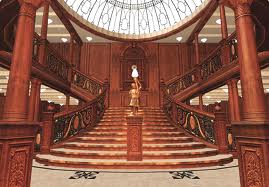
Cameron is notorious for his attention to detail and Titanic is no exception.  Witness the impeccable wardrobe, the authentic White Star Line props, the hellish engine room, the grand staircase set and the opulent dining room.  Even the most jaded viewer has to admit that Cameron spared no expense in faithfully recreating vast tracts of the fabled ship.


Unfortunately the same can't be said for the characters who populate his film.  Ethnic stereotypes like Fabrizio (Danny Nucci) are about as deep as Chef Luigi in The Simpsons.  Beyond the accent, we know that Tommy Ryan (Jason Barry) is Irish because he says things like "arse" and "boyo".  I've also harbored a deep suspicion that "Olaf" and "Sven" are the only two Swedish names that Cameron knows.

Even prominent historical characters get a short shift.  Jonathan Hyde's size-obsessed Bruce Ismay is depicted as an ignorant ("Freud? Is he a passenger?"), egotistical dandy who mindlessly drives the Titanic onward and then surreptitiously slinks into one of the lifeboats like a cat burglar.  Call me crazy, but I don't buy for a second that this real-life historical figure was ever so one-dimensionally villainous.


More examples abound.  The otherwise awesome David Warner plays Spicer Lovejoy, perhaps the most ironically named character in cinema history.  Although Warner is an incredibly accomplished actor, here he's relegated to playing a boring, stone-faced ogre.  In a performance that would be more at home in Judgment at Nuremberg, Jonathan Phillips's sweaty and twitchy Officer Lightoller apparently under fills the lifeboats just for the hell of it.

Honestly, there very little nuance or subtlety here.  Characters are either beatific and cultured or unrepentantly cuntish.  Not surprisingly, Cameron breaks this down according to class divide.  Yes, I know that there were probably a slew of real-life examples to support this, but the way in which the first class passengers say and do things just to get viewers to hiss and boo them is insultingly puerile. 


For example, Rose's bloodless (s)mother Ruth (Frances Fisher) is constantly baiting the audience with a veritable checklist of utilitarian rich bitch lines like "Charmed I'm sure", "The purpose of university is for a woman to find a husband" and "Will the lifeboats be seated according to class?  I hope they're not too crowded."  As a character, Ruth really has no reason to say these things except to draw the ire of an indignant audience with a superiority complex.

Billy Zane's Cal Hockley fares even worse.  Even though it would be in his own best interest to feign interest in art in order to pacify Rose, he constantly says acerbic, assholish things like "Picasso?  He won't amount to a thing!"  As if that doesn't get the easily-manipulated masses feeling self-righteous, Cal then matter-of-factly states that the "better half" won't die on the boat and then follows this up by using an innocent child as a life preserver.  Despite Zane's proficient and gung-ho interpretation of the material, it's no surprise to me to me that he became eternally typecast as the prototypical douchebag.

 
There are whole tracts of dialogue that are just a shade or two above something found in a George Lucas script.  Lines range from wince-inducing to tin-eared to laughably anachronistic.  Some of the more amusing examples include:
  •  "Are you ready to go back to Titanic?"  Honestly, Bill Paxton deserved an Oscar for keeping a straight face while delivering that particular howler. 
  • "God himself could not sink this ship!" declares Cal at one point.  Honestly, would a supposedly religious dude in 1912 ever say something so sacrilegious?  Not to mention foreshadowy?  
  •  "We don't have lice, we're Americans!"  'Nuff said. 
  • "Hey, can I bum a smoke?"  I wonder if DeCaprio had to ask Cameron if he could drop Jack's reference to Lovejoy as "dude"?  
  • "She was a one-legged prostitute."  I really wish Jack had went on to say: "See?  There's the kick-stand!"
  • "You unimaginable bastard" probably looked a lot better on paper then it did being uttered by what's supposed to be, in theory, a real human being.   
The lackadaisical infection of contemporary dialogue also taints the romance at the core of the story.  I'm willing to accept the film's premise that two people from opposite ends of the then-intractable social spectrum could fall in love, but the speed in which Rose dispenses with twenty years worth of  manners and social brainwashing is a conceit that I just can't forgive.  In fact, her only scene of indignation comes after Jack asks her if she loves Cal. 


The next thing we know she's hawking loogies over the side of the ship, flashing the middle finger, posing nekkid for an impromptu life drawing class and getting pounded below deck (in more ways then one).  This last miss-step is Cameron's most egregious.  Although the entire "sketch" scene is highly improbable within itself (given the downright prudish post-Victorian attitudes towards nudity back then), the sequence as it stands is super-charged with sensuality.  This could have have been the perfect consummation for the pair, but then Cameron has to go and ruin it by having Jack and Rose turn a Model T into a Turkish Bathhouse.  Honestly, if I didn't know any better I'd swear this was a post-screen-test pick-up.           

Mercifully, the holes in Titanic are nearly patched up by a cast of incredibly talented actors.  Kathy Bates is a delight as the "Unsinkable" Molly Brown.  Bernard "Theoden" Hill is a study of Zen calm and constrained wisdom as Captain E.J. Smith.   Finally, Victor Garber is fantastic as Thomas Andrews, the ship's engineer.  Soft spoken, contrite and humble, the character becomes a supremely tragedy figure when the Titanic's fatal flaw becomes apparent.   


And sorry, guys, no matter how much you like to rag on DiCaprio, he gives a strong, gregarious and charismatic performance here, even succeeding in the nigh-impossible task of selling the script's hokier lines.  Kate Winslet is his more-then-perfect match.  She's winsome, plucky, sympathetic and, more importantly, she can even deliver clunkers like "Put your hands on me, Jack" with gravitas.

The sinking of the ship itself brings me back to the bouncy castle photo and my final criticism of the film.  The gratuitous shots of passengers luging down the full length of the deck or caroming off the propellers and capstans like human Plinko chips is pretty fucking tasteless.  Cameron could easily have implied this with a few well-timed cuts but instead his camera lingers on these ghoulish sights like a hyperactive twelve year old frying bugs underneath a magnifying glass.  Sadly, I can still recall the unintentional laughter in the theater, a natural by-product for such a tonally bizarre and surreal sight.


Bottom line: I really wish that Cameron had applied the same obsessive-compulsive attention to detail towards making his directorial style, characters and dialogue dovetail with the historical setting.   In being so lax, Titanic became the ersatz blueprint for even more aggegious cinematic affronts to real-life historical events (such as the truly irredeemable Pearl Harbor).  At least Titanic is well-acted, competently directed and functions as an expertly (de)constructed piece of entertainment.

But having said that, with each subsequent viewing of Titanic it feels more and more as if Cameron snagged a bunch of modern-day actors, dressed them up in period clothes and then set them loose on the equivalent of his own inflatable bouncy castle.


      Tilt: down. 


Wednesday, April 11, 2012

T.V. Review: "Being Human" (U.K.) Series One-Three

Hullo, Supernaturalists!

I don't know about the rest of you guys but personally I'm sick to death of friggin' vampires, werewolves and demons.  Especially neutered, mopey, glittery tossers who neither bite nor bang things.  Mercifully, screenwriter Toby Whithouse has come to the rescue with Being Human, a palate-cleansing flat-mate horror comedy with genuine bite.

Here's a promo for the show just to lay some groundwork...


The first episode introduces us to George (Russell Tovey), a milquetoast male nurse who's come down with an acute case of lycanthropy after an unfortunate hiking trip in Scotland.  He's friends with Mitchell (Aiden Turner) a one-hundred year old Irish vampire who works as an orderly in the same hospital.  Despite their afflictions, both men do whatever they can to retain some semblance of their humanity.  George attempts to isolate himself during "that time of the month" and Mitchell fights to stay on the wagon and refrain from drinking blood.

When the two of them move into a new house together they discover that it's haunted by Annie (Lenora Critchlow) a beautiful young ghost struggling with denial issues.  Because of their supernatural natures, both Mitchell and George have no problem seeing Annie,  who seems relieved to finally have some company who can interact with her.


Together these three unlikely roommates do what they can to fit into normal society, but their task isn't easy.  Annie discovers a terrible truth surrounding her mysterious demise.  George's tentative attempts at romance are undermined by his brutal alter-ego.  Undead enablers incessantly try to undermine Mitchell's attempts to go straight for their own nefarious purposes. 

The cast is wonderful.  Jug-eared Russell Tovey plays George to sad-sacked perfection.  Although the character occasionally lapses precariously into emo territory I'm willing to forgive this somewhat.  After all, if you experienced an agonizing flesh-and-bone-rending transformation every month which threatened the lives of your loved ones you'd probably be cranky too.  We see this played out in his tentative relationship with Nina (Sinead Keenan), a feisty nurse who's concealing her own inner demons.


Lenora Crichlow plays Annie as charmingly naive and immature.  Although she's sometimes ruled by her emotions and is occasionally undone by blind trust, we also soon see that it's not wise to cross her, especially where it concerns her new found allies.  Over the course of twenty-two episodes Annie experiences considerable growth and change.  She starts out as a sheltered, cloying and somewhat helpless waif but after some fortuitous encounters with fellow spirits Gilbert (Alex Price) and Sykes (Bryan Dick) she becomes considerably more self-reliant.  

The only character that I find somewhat conventional is Mitchell.  This isn't a slight against actor Aiden Turner who's appropriately intense and compelling to watch, it's just that we've seen the whole "tortured vampire" shtick done to death.  Mercifully the show gives this tired concept a refreshing spin by really exploring the concept of vampirism as drug addiction.  Mitchell's day-to-day struggle with "sobriety" is documented with such realism that I'm willing to forgive the fingerless gloves and occasional histrionics.  


Its minimalist budget and matter of fact production design really gives Being Human an authentic quality rarely matched by American television.  Setting the first two Series in quirky-yet-workaday Bristol was a minor stroke of genius.  The house shared by the three protagonists is a run-down dive with dirt marks on the light switches.  The minor characters and background performers actually resemble real people and not precious, rarefied mannequins.

The limited budget also forces the show runners to get creative.  The special effects team does an incredible job depicting the painful  early stages of George's transformation, conjuring up shades of David Naughton in American Werewolf in London.  Knowing that audience imagination is more powerful then anything they can possibly depict on screen, the producers initially limit full-body shots of the final stage werewolf suit to quick cuts, shadows and silhouette.  


This is born out when the producers are forced to show George in final lupine form at the climax of the first Series.  As expected, the full-scale costume looks a tad hokey, but certainly nothing worse then what we've seen on Buffy the Vampire Slayer or in Ginger Snaps.  I'm pleased to report that the suit improves dramatically in the Second and Third series, eventually coming to resemble a cross between the werewolves  in The Howling and Dog Soldiers. 

The show's world-building continues to deepen and mature in Series Two and Three.  Mitchell's diabolical sire Herrick (played with cool menace by Jason Watkins) is taken out through unconventional means, but comes back to sow seeds of dissent.  Nina is injured in a tragic accident, causing George to justify his feelings of isolationism.  Even after unraveling the mystery surrounding her own demise, Annie isn't given the option to cross over to the afterlife.  Despite finding new purpose in her paranormal state, she's victimized by a secretive religious sect who end up forcing the issue.


Whithouse and company certainly don't mind fucking around with conventions and audience expectations.  The writers have no compunction doing truly horrendous things to their characters.  Also, since it's the BBC, they often blindside us with unexpected and shocking burst of sex and/or violence.  Honestly, it's the perfect antidote to conventional North American television which comes across as sterile, non-threatening and paint-by-numbers in comparison.   

Tonally the show is gloriously all over the map.  Episodes have dealt with such dark topics as sexual assault ("Tully"), pedophilia ("The Black Day") torture ("Long Live the King") and even mass murder ("Damage").  The writers also betray their coal-black sense of humor by conjuring up such memorable characters as the zombified slag Sasha in "Type 4" and the Hargreaves from "Adam's Family", who turn out to be rich, degenerate swingers who conveniently keep blood-bag gimps trussed up in their dungeon. 

Above all, every Series finale episode I've watched thus far has been a nail-biter.  The gloriously anarchic Series One capper featured George pitting his inner wolf against the Big Bad, resulting in collateral damage.  The final episode of Series Two is even more intense, with George and Nina on the verge of "scientific" sacrifice, Annie ghost-busted against her will and Mitchell going completely bat-shit insane.  Unable to match the frantic climax of Season Two, the writers go for a more intimate and emotional conclusion for Series Three that makes good on its promise to irrevocably change the face of Being Human forever.  

Despite having to navigate around conventional pitfalls and occasionally lapsing into melodrama, Being Human is a very brave, very smart and very engaging show. I'd love to watch its American counterpart just to see how much it misses the point.


   Tilt: up.  


Friday, April 6, 2012

Movie Review "The Matrix" by David Pretty


When I first saw The Matrix over ten years ago I was overjoyed that the sci-fi pantheon had finally received a new and particularly thrilling inductee.  Indeed, the film is still inordinately smart, action-packed and in many ways the high water mark of visual storytelling.

Then something interesting happened.  After a chance encounter many years later with what I now refer to as "alternative media" I actually experienced an epiphany not unlike what Neo goes though after swallowing the red pill and diving down the rabbit hole.  As a result, I've since come to view The Matrix as more then just a superficial, though admittedly well-done, sci-fi time-killer.  It has loads to say about the current state of the human condition and I firmly believe that it's one of the most important films made in the past twenty years.


For all of you under-rock dwellers out there, the story follows the awakening of Thomas Anderson (Keanu Reeves), a respectable software developer who seeks answers to nagging questions under the hacker guise of "Neo".  Sensing that there's something seriously askew in the world, he seeks out the only custodian of the truth: a mysterious hacker prophet/cyber terrorist named Morpheus (Laurence Fishburne).

Just prior this fateful meeting, Anderson is menaced by men-in-black style federal agents, led by the cold and measured Mr. Smith (Hugo Weaving).  In a particulalrly harrowing scene, Anderson is tortured by the agents who implant a bio-mechanical tracking bug in his body.  When he wakes up safe and sound in own bed sometime later, he's able to write off the whole experience as a particularly nightmarish dream.

But when Trinity (Carrie-Anne Moss) unexpectedly shows, Neo is quickly forced to come to grips witht he fact that electronic tracking is the least of his worries.  The scenes that follow between Neo and Morpheus really encapsulate the film's thematic parable and is well-represented by the following chilling exchange of dialogue:


Morpheus: The Matrix is everywhere.  It is all around us.  Even now, in this very room.  You can see it when you look out your window or when you turn on your television.  You can feel it when you go to work, when you go to church, when you pay your taxes.  It is the world that has been pulled over your eyes to blind you from the truth.

Neo: What truth?

Morpheus: That you are a slave, Neo.  Like everyone else you were born into bondage.  Into a prison that you cannot taste or see or touch.  A prison for your mind...

I've since come to equate Neo's reawakening to my own experience.  Like Neo, I was convinced that there was something terribly wrong with the world but I just couldn't put my finger on it.  Suspecting that the mainstream, corporate-controlled media was concealing something from all of us, I began to do my own independent research and stumbled upon the world of alternative media.  It quickly became my own personal Morpheus, revealing the world for what is truly is.

When Neo is reborn into the real, physical world later on, we get the following rife-with-analogy exchange:


Neo: Why do my eyes hurt?

Morpheus: You've never used them before.

I could relate.  How often can you say that a film actually had a life-altering effect on you?  I feel churlish just giving it a star rating and urging folks to re-watch it with the rich subtext firmly in mind. 

And that's what makes The Matrix so brilliant.  It's a perfect parable for the world at face value and it invites the viewer to tear back the edifice and look at what's concealed just below the surface.  It reminds us that the truth is out there, waiting to be discovered.  We just need to follow the White Rabbit to it's inevitable conclusion.

The Matrix is a visual treat and a truly cinematic experience.  In addition to pioneering the concept of "bullet time" (which has been blatantly cribbed by every movie and video game since 1999) the shot compositions are wildly inventive, highly stylized and reminiscent of a comic book.  The film's production design is also top notch.   The elaborate sets and machanical antagonists display Moebius-like levels of surface detail and really make for a convincing illusion.


The color palate of the machine is constantly on display.  The Wachowski's use this to great effect to drive home just how much technology has permeated our culture.  After all, we now live in a day and age when the latest techy toy is often characterized as "sexy".  Everything looks appropriately cold, antiseptic and dour.  Even the fabric tunics worn by the Nebuchadnezzar crew reminds the viewer of medieval chain mail.

Some people gripe about the workmanlike and robotic dialogue.  Frankly I think it was brilliant to have the protagonists speak like shut-ins.  I take it as an insightful commentary on how face-to-face interactions are swiftly being replaced by impersonal email and text messages and causing all of us to become more and more socially inept.

The performances have become so iconic that they're still the subject of parody and tribute.  Reeves, oft-maligned for being stilted, is perfectly at home in Neo's skin and convincingly completes his character arc.  Fishburne's Morpheus is everything you need a mentor to be: self-assured, Zen-calm and authoritative.  Carrie-Ann Moss makes for an unconventional love interest but I challenge anyone else to think of a more appropriate choice for the role of Trinity.  In fact, one of the exciting things about the Matrix universe is that a thirty year old, healthily proportioned woman with short, raven-black hair can be immortalized as a sex symbol.

Of course, the skin-tight leather outfit certainly helped.


The action set pieces are beautifully mounted and augmented by the rule-shattering milieu.  The lobby gunfight sequence rivals the best of John Woo's Hong Kong action films and the kung-fu/wire work never fails to impart a giddy thrill in the viewer.  The Wachowski's also managed to throw an original visual curve ball at us in the form of "bullet time".  I have to admit: the first time I saw Trinity suspend reality and punt a cop across the room or witness Neo perform a power-limbo while evading a hail of flying lead, my brain exploded and leaked out of my right ear.

The Matrix is a brilliant concept perfectly realized. You can enjoy the film on a completely visceral level but after all the spent shells and high-octane action I'd invite all of you to revisit it again with the state of our own world in mind.

You'll find that this slick sci-fi actioner has a lot to say about the state of human existence in a technology-soaked, invisibly regimented, completely apathetic modern age.